
Nishi-funabashi Station
T23 · Tozai Line · Funabashi, Chiba
Nishi-funabashi Station (西船橋)
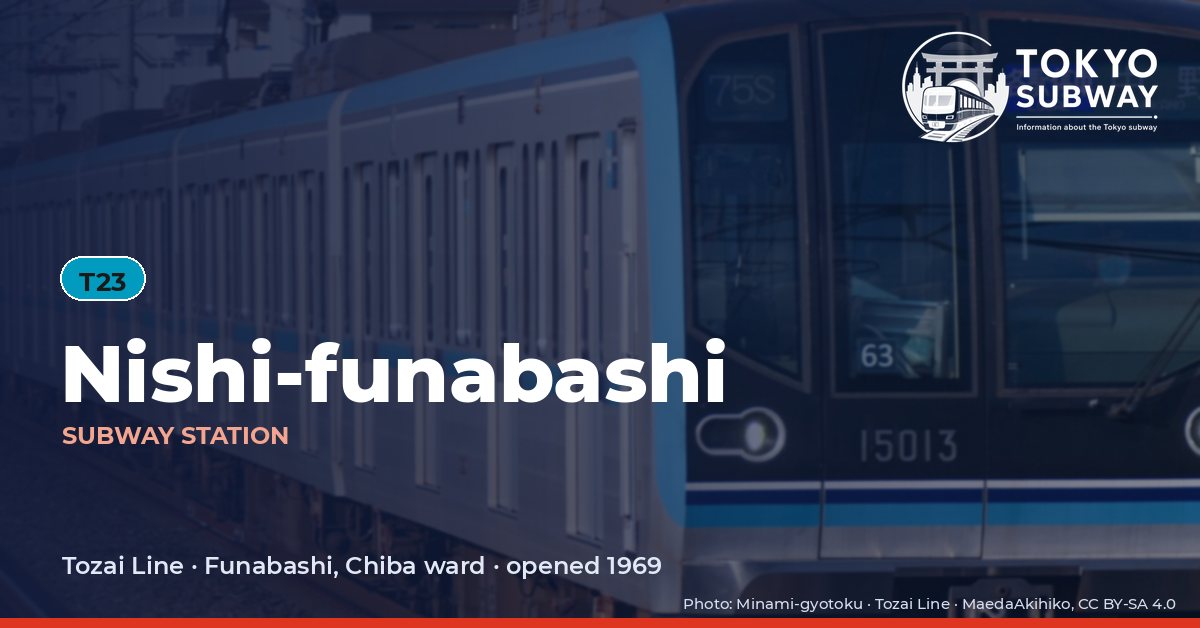
Nishi-funabashi is the easternmost station of the Tokyo subway and it is not in Tokyo: T23 stands in Funabashi, Chiba, where the Tozai Line arrived on 29 March 1969 and began running through onto JR’s Sobu tracks the same day. The station it joined had opened on 10 November 1958 and has kept growing ever since — high-level platforms for the Musashino Line from 2 October 1978, Keiyo Line services from 3 March 1986, and the Toyo Rapid Railway from 27 April 1996, which also runs through onto the subway.
The result is six island platforms and eleven tracks on two levels, plus two more that Sobu Rapid trains use without stopping. Within the subway section, platform 5 is mainly for Toyo Rapid services, platform 8 is used by Tozai Line trains alone, and platforms 6 and 7 handle trains that terminate and reverse. Tokyo Metro counted 272,840 entries and exits a day here in the 2025 survey, a figure swollen by the through traffic in both directions.
Finding Nishi-funabashi on the signs
Every line gives the station its own letter-and-number code. You never have to read the Japanese name to find the right platform.
Station numbers at Nishi-funabashi
Tokyo signposts every platform, exit and train door with a letter and a two-digit number. Matching the number is faster than reading the name — and it is what you will see on the map, in announcements and on the platform edge.
First and last trains at Nishi-funabashi
| Line and direction | Weekdays first – last | Saturdays, Sundays & holidays first – last |
|---|---|---|
| TTozaiT23 towards Nakano | 05:00 – 00:09 to Toyocho | 05:00 – 00:09 to Toyocho |
Departure times come from the operators’ own GTFS timetables (ODPT GTFS Toei-Train-GTFS (version 20261009, valid 2026-03-14..2027-03-12) + TokyoMetro-Train-GTFS (version 20261008, valid 2026-09-19..2027-03-12)). Japan publishes two subway timetables: 平日 weekdays and 土休日 Saturdays, Sundays and national holidays. There is no separate Sunday timetable, and the December 30 – January 3 period runs the holiday timetable.
How often do trains run?
| Line | Weekdays, busiest hour | Sat / Sun / holidays, busiest hour |
|---|---|---|
| TTozai | 19 trains/hour (about one every 3.2 min) | 14 trains/hour |
Departures in one direction during the hour with the most trains at this station, counted in the operators’ timetable.
Next stations from Nishi-funabashi
Scheduled running time between Nishi-funabashi and the stations either side of it.
| Line | Next station | Running time |
|---|---|---|
| TTozai | T22Baraki-nakayama | 3 min |
Transfers and connections
- JR: Chuo-Sobu Local Line (JR East), Keiyo Line (JR East), Musashino Line (JR East). These are separate railways with their own fares.
- Other railways: Toyo Rapid Line (Toyo Rapid Railway). These are separate railways with their own fares.
Accessibility
| Line | Step-free by elevator | Accessible toilet | Escalator | Exits |
|---|---|---|---|---|
| TTozai | Yes | Yes | Yes | 2 |
- Tozai Line: Step-free elevator route street-gate-platform (official “1-route by elevator”). Street elevator at exit(s): 北口. Operator page (checked Oct 20, 2026).
Taken from the operators’ own accessibility pages and nothing else. Tokyo Metro: the “1-route” (step-free street-gate-platform path by elevator, slope, stair lift or wheelchair escalator) is complete at all 180 stations; a separate list shows stations with an elevator-only 1-route.
What is near Nishi-funabashi Station?
For so large an interchange the surroundings are quiet, and most people pass through rather than come out. Funabashi’s Nishi-Funabashi branch office is about 340 m from the exits and the city’s west library roughly 350 m, with a language school around 360 m and Katsumada park about 390 m; a highway bus reservation office stands some 120 m away. Baraki-nakayama is the next subway station along.
| Place | Distance (straight line) | On foot, estimated |
|---|---|---|
| Katsumada park 勝間田公園 | 390 m | about 6 min |
| 西船4丁目緑地 | 310 m | about 5 min |
| Kikokushijo Academy 帰国子女アカデミー | 360 m | about 6 min |
| Funabashi City Nishi-Funabashi Branch Office 船橋市西船橋出張所 | 340 m | about 6 min |
| Funabashi City West Library 船橋市西図書館 | 350 m | about 6 min |
| 京成高速バス予約センター | 120 m | about 2 min |
Places from OpenStreetMap within 400 m of the station. The walking time is an estimate (straight line plus 30 %, 80 m a minute), not a measured route. © OpenStreetMap contributors, ODbL.
Frequently asked questions
It is the end of the subway, and the easternmost point of the Tokyo subway network, but many trains keep going: services run through onto the Toyo Rapid Railway toward Katsutadai and onto JR East’s Sobu tracks toward Chiba, so check the destination rather than assuming you must change.
Platforms 5 to 8 in the low-level section. Platform 5 is mainly for Toyo Rapid trains, platform 8 for Tozai Line services only, and platforms 6 and 7 are used mostly by trains terminating and reversing, with some through workings at the peaks.