
Myoden Station
T21 · Tozai Line · Ichikawa, Chiba
Myoden Station (妙典)
Myoden is the youngest station on the Tozai Line, and it spent its first thirty years as a place where trains slept. Opened on 29 March 1969 as the Shimo-Myoden signal station, it was where services starting from Gyotoku waited beside the depot. Housing spread, work on a passenger station began in February 1997, the name was settled in June 1999 and T21 opened on 22 January 2000 at a cost of about ¥5.66 billion.
What was built is unusually generous for a suburban stop: two island platforms and four tracks on the third floor of the structure, with the outer tracks carrying the main line and the inner pair used as loops. The platform on the Nakano side was widened to 10 m, well beyond the 6.5 m first planned, after the traffic forecasts were revised, and an extra track was laid so trains can come straight out of the Gyotoku depot. A shopping arcade opened under the station in April 2000 and solar panels were added in 2012.
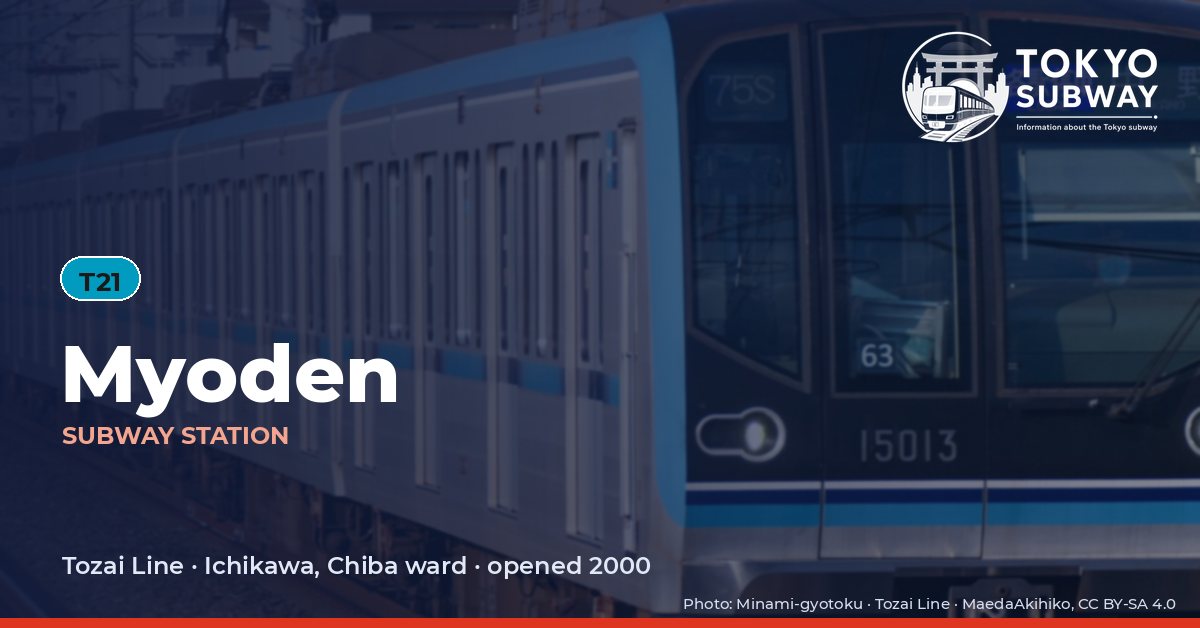
Finding Myoden on the signs
Every line gives the station its own letter-and-number code. You never have to read the Japanese name to find the right platform.
Station numbers at Myoden
Tokyo signposts every platform, exit and train door with a letter and a two-digit number. Matching the number is faster than reading the name — and it is what you will see on the map, in announcements and on the platform edge.
First and last trains at Myoden
Departure times come from the operators’ own GTFS timetables (ODPT GTFS Toei-Train-GTFS (version 20261009, valid 2026-03-14..2027-03-12) + TokyoMetro-Train-GTFS (version 20261008, valid 2026-09-19..2027-03-12)). Japan publishes two subway timetables: 平日 weekdays and 土休日 Saturdays, Sundays and national holidays. There is no separate Sunday timetable, and the December 30 – January 3 period runs the holiday timetable.
How often do trains run?
| Line | Weekdays, busiest hour | Sat / Sun / holidays, busiest hour |
|---|---|---|
| TTozai | 16 trains/hour (about one every 3.8 min) | 12 trains/hour |
Departures in one direction during the hour with the most trains at this station, counted in the operators’ timetable.
Next stations from Myoden
Scheduled running time between Myoden and the stations either side of it.
| Line | Next station | Running time |
|---|---|---|
| TTozai | T22Baraki-nakayama | 3 min |
| TTozai | T20Gyotoku | 2 min |
Transfers and connections
Only the Tozai Line stops here, and no other railway serves this station, so there is nothing to transfer to inside the station.
Accessibility
| Line | Step-free by elevator | Accessible toilet | Escalator | Exits |
|---|---|---|---|---|
| TTozai | Yes | Yes | Yes | 3 |
- Tozai Line: Step-free elevator route street-gate-platform (official “1-route by elevator”). Operator page (checked Oct 20, 2026).
Taken from the operators’ own accessibility pages and nothing else. Tokyo Metro: the “1-route” (step-free street-gate-platform path by elevator, slope, stair lift or wheelchair escalator) is complete at all 180 stations; a separate list shows stations with an elevator-only 1-route.
What is near Myoden Station?
Myoden belongs to Ichikawa in Chiba, on reclaimed ground near the Edo River mouth, and the area is almost entirely housing. Shirotae Park is about 50 m from the exits and three more parks lie between 240 m and 370 m; an AEON supermarket and its cinema are roughly 270–390 m away, and a municipal elementary school about 180 m. The arcade under the station covers most daily shopping.
| Place | Distance (straight line) | On foot, estimated |
|---|---|---|
| Shirotae Park 白妙公園 | 50 m | about 1 min |
| 上道公園 | 240 m | about 4 min |
| すいせん公園 | 360 m | about 6 min |
| サルビア公園 | 370 m | about 6 min |
| AEON イオン | 390 m | about 6 min |
| 市川市立行徳小学校 | 180 m | about 3 min |
| AEON Cinema イオンシネマ | 270 m | about 4 min |
Places from OpenStreetMap within 400 m of the station. The walking time is an estimate (straight line plus 30 %, 80 m a minute), not a measured route. © OpenStreetMap contributors, ODbL.
Frequently asked questions
There was no demand when the line was laid. The site served as the Shimo-Myoden signal station and depot approach from 1969, and only as the surrounding land filled with housing did Tokyo Metro’s predecessor build a station, starting in February 1997 and opening it on 22 January 2000.
The station has four tracks, with loops on the inside, so a local service can stand clear while a rapid train runs past. In the middle of the day that overtaking is done at Kasai instead, and when rapid trains are running, local services use the loop tracks here whether or not anything passes.