
Sumiyoshi Station
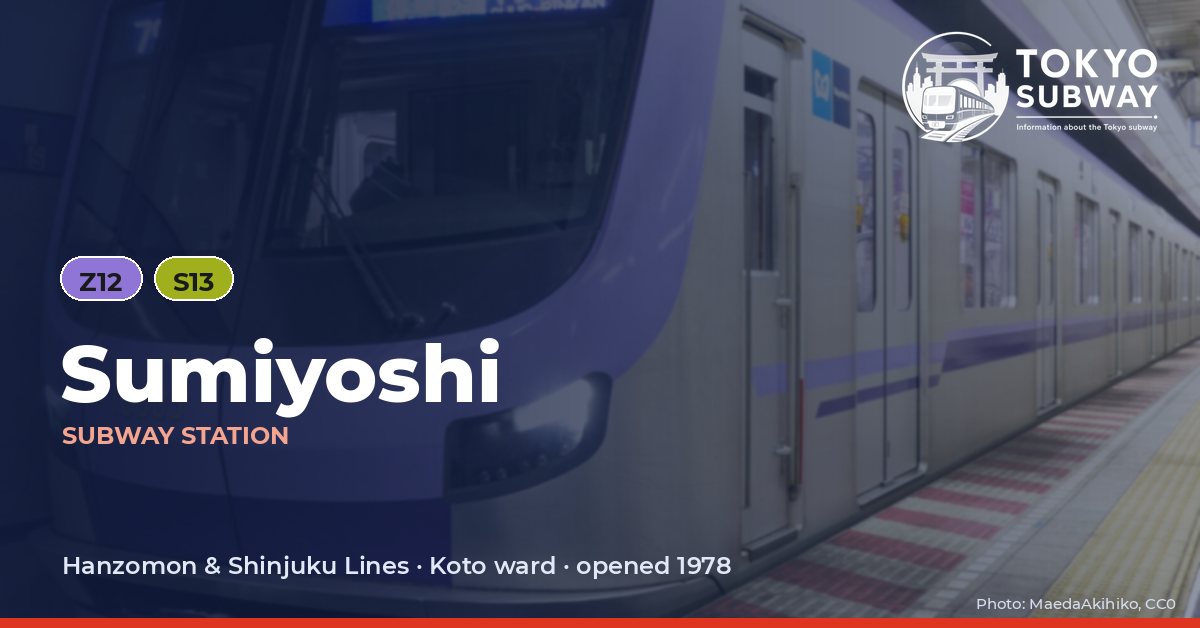
Z12 S13 · Hanzomon Line and Shinjuku Line · Koto
Sumiyoshi Station (住吉)
Sumiyoshi began as a Toei station. The Shinjuku Line opened its platforms on 21 December 1978 and S13 served the district on its own until 19 March 2003, when the Hanzomon Line ran through on its way to Oshiage and added Z12. The two companies stack rather than meet: the Toei tracks are at B2 and the Tokyo Metro tracks below them at B3 and B4, with the concourses above both.
The Toei side has two side platforms, each behind its own gate line, so passengers pick a direction before they touch a ticket machine and a mistake means coming back out to the street. The Tokyo Metro side was built as two island platforms, one above the other, but only one face of each is in service; the halves that are not used were laid for a planned link towards Toyosu and now hold stabled trains. A branch of the Yurakucho Line from Toyosu to Sumiyoshi was announced in 2021 and is not expected to carry anyone before the mid-2030s. Nothing of it exists in service today.
Finding Sumiyoshi on the signs
Every line gives the station its own letter-and-number code. You never have to read the Japanese name to find the right platform.
Station numbers at Sumiyoshi
Tokyo signposts every platform, exit and train door with a letter and a two-digit number. Matching the number is faster than reading the name — and it is what you will see on the map, in announcements and on the platform edge.
First and last trains at Sumiyoshi
| Line and direction | Weekdays first – last | Saturdays, Sundays & holidays first – last |
|---|---|---|
| ZHanzomonZ12 towards Oshiage (Skytree) | 05:09 – 00:35 | 05:09 – 00:07 |
| ZHanzomonZ12 towards Shibuya | 05:10 – 00:22 to Suitengumae | 05:10 – 23:57 |
| SShinjukuS13 towards Motoyawata | 05:22 – 00:26 to Ojima | 05:22 – 00:26 to Ojima |
| SShinjukuS13 towards Shinjuku | 05:03 – 00:07 | 05:03 – 00:07 |
Departure times come from the operators’ own GTFS timetables (ODPT GTFS Toei-Train-GTFS (version 20261009, valid 2026-03-14..2027-03-12) + TokyoMetro-Train-GTFS (version 20261008, valid 2026-09-19..2027-03-12)). Japan publishes two subway timetables: 平日 weekdays and 土休日 Saturdays, Sundays and national holidays. There is no separate Sunday timetable, and the December 30 – January 3 period runs the holiday timetable.
How often do trains run?
Departures in one direction during the hour with the most trains at this station, counted in the operators’ timetable.
Next stations from Sumiyoshi
Scheduled running time between Sumiyoshi and the stations either side of it.
| Line | Next station | Running time |
|---|---|---|
| ZHanzomon | Z13Kinshicho | 2 min |
| ZHanzomon | Z11Kiyosumi-shirakawa | 3 min |
| SShinjuku | S12Kikukawa | 1 min |
| SShinjuku | S14Nishi-ojima | 2 min |
Transfers and connections
- Subway: transfer between Hanzomon Line and Shinjuku Line. The Tokyo Metro lines and the Toei Subway lines belong to different companies, so a trip that uses both costs more than one operator alone — see fares.
Accessibility
- Hanzomon Line: Step-free elevator route street-gate-platform (official “1-route by elevator”). Street elevator at exit(s): B1, B2. Operator page (checked Oct 20, 2026).
- Shinjuku Line: Toei: step-free “1-route” secured; 2 elevator(s) on this line. Elevator exit(s): B1, B2. Operator page (checked Oct 20, 2026).
Taken from the operators’ own accessibility pages and nothing else. Tokyo Metro: the “1-route” (step-free street-gate-platform path by elevator, slope, stair lift or wheelchair escalator) is complete at all 180 stations; a separate list shows stations with an elevator-only 1-route. Toei: every station has elevators and a street-gate-platform “1-route” is secured.
What is near Sumiyoshi Station?
Sumiyoshi serves a stretch of Koto between the canals and Kinshicho, which is a walk away rather than a ride. The Sumiyoshi Ginza Shopping Arcade starts about 210 m from the exits and Sarueonshi park is about 220 m off, with Sarue Shrine at its far side. Tiara Koto, the borough concert hall, is about 340 m away, the Kodomo Plaza Library about 310 m, and Tosen Elementary School and Asoka Hospital are both within a few minutes. The Isegahata sumo stable is about 350 m from the station.
| Place | Distance (straight line) | On foot, estimated |
|---|---|---|
| Sarueonshi park 猿江恩賜公園 | 220 m | about 4 min |
| Sarue Shrine 猿江神社 | 360 m | about 6 min |
| 重願寺 | 350 m | about 6 min |
| Sumitoshi Park 住利公園 | 300 m | about 5 min |
| 猿江二丁目公園 | 340 m | about 6 min |
| LUUP ループ | 200 m | about 3 min |
| Tosen Elementary School 江東区立東川小学校 | 270 m | about 4 min |
| Fukagawa 7th Junior High School 江東区立深川第七中学校 | 330 m | about 5 min |
Places from OpenStreetMap within 400 m of the station. The walking time is an estimate (straight line plus 30 %, 80 m a minute), not a measured route. © OpenStreetMap contributors, ODbL.
Frequently asked questions
Because its two platforms are side platforms, each reached from its own ticket hall, with no link between them inside the barrier. You decide which way you are going at street level. The Hanzomon Line platforms below are islands and do not have the problem.
The Tokyo Metro station was built as two island platforms stacked one above the other, which gives four possible track faces. Only one face on each level carries passengers. The others were provided for an extension towards Toyosu that was never built on that alignment, and they are used today for stabling trains.