
Kinshicho Station
Z13 · Hanzomon Line · Sumida
Kinshicho Station (錦糸町)
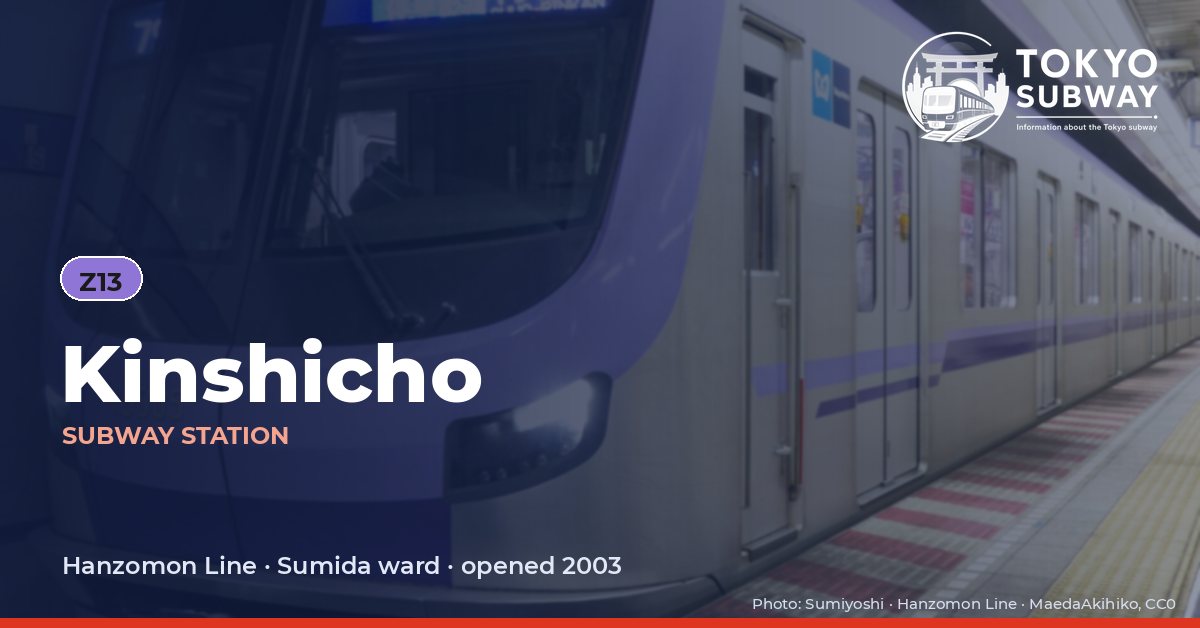
Trains have called at Kinshicho since 9 December 1894, but the subway took more than a century to reach them: the Hanzomon Line platform, Z13, opened on 19 March 2003, built by the Teito Rapid Transit Authority barely a year before the authority was privatized and its stations passed to Tokyo Metro. The result is a two-operator complex in which the older half, run by JR East, carries both the Chuo-Sobu Local and the Sobu Rapid lines, while the newer half is pure Hanzomon Line.
Tokyo Metro counted 108,419 entries and exits a day at its own gates in the 2025 survey, which for a line opened here in 2003 says a good deal about the transfer traffic; the stretch from Kinshicho toward Ryogoku appeared in the 2015 transport ministry figures among the most crowded rush-hour segments in Tokyo. Hanzomon trains do not stop at the subway boundary either: they run through onto Tobu and Tokyu tracks at both ends.
Finding Kinshicho on the signs
Every line gives the station its own letter-and-number code. You never have to read the Japanese name to find the right platform.
Station numbers at Kinshicho
Tokyo signposts every platform, exit and train door with a letter and a two-digit number. Matching the number is faster than reading the name — and it is what you will see on the map, in announcements and on the platform edge.
First and last trains at Kinshicho
| Line and direction | Weekdays first – last | Saturdays, Sundays & holidays first – last |
|---|---|---|
| ZHanzomonZ13 towards Oshiage (Skytree) | 05:11 – 00:36 | 05:11 – 00:09 |
| ZHanzomonZ13 towards Shibuya | 05:08 – 00:20 to Suitengumae | 05:08 – 23:55 |
Departure times come from the operators’ own GTFS timetables (ODPT GTFS Toei-Train-GTFS (version 20261009, valid 2026-03-14..2027-03-12) + TokyoMetro-Train-GTFS (version 20261008, valid 2026-09-19..2027-03-12)). Japan publishes two subway timetables: 平日 weekdays and 土休日 Saturdays, Sundays and national holidays. There is no separate Sunday timetable, and the December 30 – January 3 period runs the holiday timetable.
How often do trains run?
| Line | Weekdays, busiest hour | Sat / Sun / holidays, busiest hour |
|---|---|---|
| ZHanzomon | 21 trains/hour (about one every 2.9 min) | 14 trains/hour |
Departures in one direction during the hour with the most trains at this station, counted in the operators’ timetable.
Next stations from Kinshicho
Scheduled running time between Kinshicho and the stations either side of it.
| Line | Next station | Running time |
|---|---|---|
| ZHanzomon | Z14Oshiage (Skytree) | 2 min |
| ZHanzomon | Z12Sumiyoshi | 2 min |
Transfers and connections
- JR: Chuo-Sobu Local Line (JR East), Sobu Rapid Line (JR East). These are separate railways with their own fares.
Accessibility
| Line | Step-free by elevator | Accessible toilet | Escalator | Exits |
|---|---|---|---|---|
| ZHanzomon | Yes | Yes | Yes | 5 |
- Hanzomon Line: Step-free elevator route street-gate-platform (official “1-route by elevator”). Street elevator at exit(s): 1, 4. Operator page (checked Oct 20, 2026).
Taken from the operators’ own accessibility pages and nothing else. Tokyo Metro: the “1-route” (step-free street-gate-platform path by elevator, slope, stair lift or wheelchair escalator) is complete at all 180 stations; a separate list shows stations with an elevator-only 1-route.
What is near Kinshicho Station?
The blocks around the exits form the largest shopping district in Sumida, and much of it is within a short walk of the gates: Arcaeast about 60 m away, Kinshicho PARCO and Arcakit Kinshicho around 150–220 m, Kinshicho Marui about 300 m, and the Termina complex at the JR station. Sumida Kinshi Park is roughly 220 m out, with Sumida Triphony Hall and the Sumida City Gymnasium nearby for concerts and events.
| Place | Distance (straight line) | On foot, estimated |
|---|---|---|
| Sumida Kinshi Park 墨田錦糸公園 | 220 m | about 4 min |
| Arcakit Kinshicho アルカキット錦糸町 | 220 m | about 4 min |
| Arcaeast アルカイースト | 60 m | about 1 min |
| Kinshicho PARCO 錦糸町パルコ | 150 m | about 2 min |
| Kinshicho Marui 錦糸町マルイ | 300 m | about 5 min |
| Kinshibori Park 錦糸堀公園 | 330 m | about 5 min |
| 千種稲荷神社 | 80 m | about 1 min |
| Silk Road Cafe | 270 m | about 4 min |
Places from OpenStreetMap within 400 m of the station. The walking time is an estimate (straight line plus 30 %, 80 m a minute), not a measured route. © OpenStreetMap contributors, ODbL.
Frequently asked questions
It is one stop away: Oshiage (Skytree) is the next station along the Hanzomon Line. Kinshicho’s own role is the interchange with JR East, where the Sobu Rapid and Chuo-Sobu Local lines share the station name.
It is a funnel. The Tokyo Metro gates alone handled 108,419 entries and exits a day in the 2025 survey, and in the transport ministry’s 2015 data the run out of Kinshicho toward Ryogoku was listed among the most crowded rail segments in the city.