Mizue Station
S19 · Shinjuku Line · Edogawa
Mizue Station (瑞江)
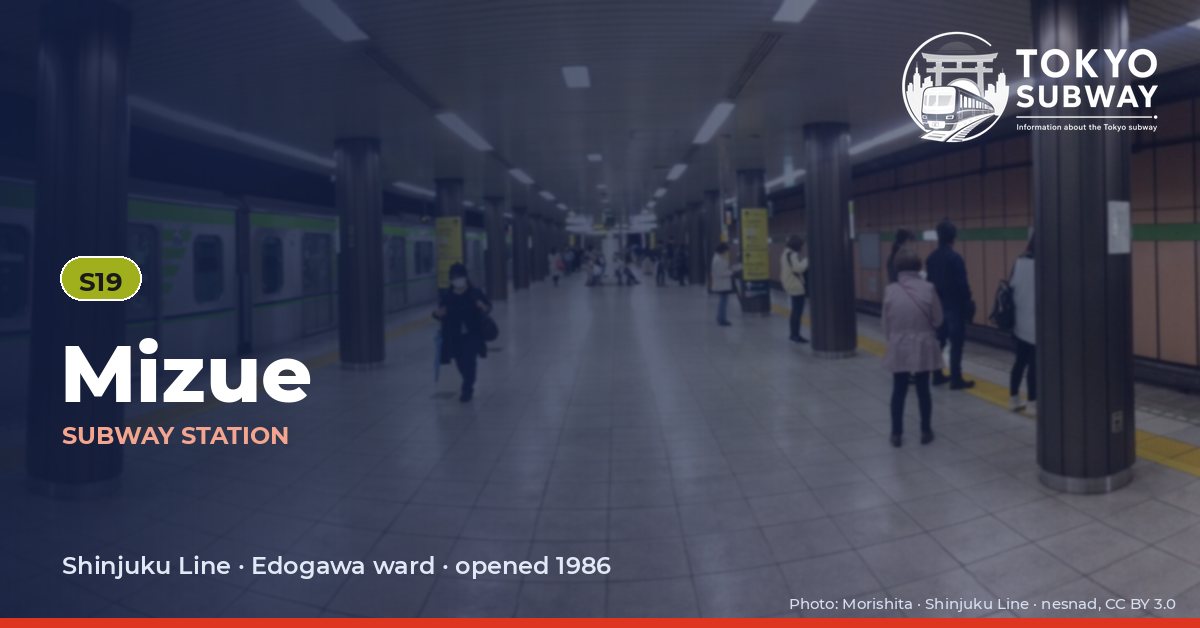
Mizue was built with overtaking in mind. The Shinjuku Line extension from Funabori to Shinozaki brought S19 into use on 14 September 1986 — the works had called it Nishi-Mizue — with an island platform on two loop tracks and a through track on each outer side. Walls separate the platform from those outer tracks, so a passing express is heard rather than seen. The Motoyawata-direction through track was only commissioned on 24 December 1997, when express running began on the line; under the timetable introduced on 16 March 2024 no scheduled overtaking happens here at all.
The station sits beneath a building owned by the Tokyo Kotsu Kaikan, in the middle of a residential part of Edogawa, and platform screen doors came into use on 9 June 2018. Trains from here run through onto Keio tracks beyond the subway.
Finding Mizue on the signs
Every line gives the station its own letter-and-number code. You never have to read the Japanese name to find the right platform.
Station numbers at Mizue
Tokyo signposts every platform, exit and train door with a letter and a two-digit number. Matching the number is faster than reading the name — and it is what you will see on the map, in announcements and on the platform edge.
First and last trains at Mizue
| Line and direction | Weekdays first – last | Saturdays, Sundays & holidays first – last |
|---|---|---|
| SShinjukuS19 towards Motoyawata | 05:11 – 00:18 | 05:11 – 00:18 |
| SShinjukuS19 towards Shinjuku | 05:06 – 00:15 to Ojima | 05:06 – 00:15 to Ojima |
Departure times come from the operators’ own GTFS timetables (ODPT GTFS Toei-Train-GTFS (version 20261009, valid 2026-03-14..2027-03-12) + TokyoMetro-Train-GTFS (version 20261008, valid 2026-09-19..2027-03-12)). Japan publishes two subway timetables: 平日 weekdays and 土休日 Saturdays, Sundays and national holidays. There is no separate Sunday timetable, and the December 30 – January 3 period runs the holiday timetable.
How often do trains run?
| Line | Weekdays, busiest hour | Sat / Sun / holidays, busiest hour |
|---|---|---|
| SShinjuku | 15 trains/hour (about one every 4 min) | 12 trains/hour |
Departures in one direction during the hour with the most trains at this station, counted in the operators’ timetable.
Transfers and connections
Only the Shinjuku Line stops here, and no other railway serves this station, so there is nothing to transfer to inside the station.
Accessibility
| Line | Step-free by elevator | Accessible toilet | Escalator | Exits |
|---|---|---|---|---|
| SShinjuku | Yes | Yes | Yes | 2 |
- Shinjuku Line: Toei: step-free “1-route” secured; 1 elevator(s) on this line. Elevator exit(s): 要翻訳. Operator page (checked Oct 20, 2026).
Taken from the operators’ own accessibility pages and nothing else. Toei: every station has elevators and a street-gate-platform “1-route” is secured.
What is near Mizue Station?
Mizue is a commuter station in a residential grid, and almost everything around it is local: Lapark Mizue for shopping, the Tobu Friend Hall and the Tobu Citizen’s Hall for events, and the Mizue Daiichi Hotel. A neighborhood park lies about 170 m from the exits and another roughly 340 m. Keisei buses leave from outside for Koiwa, Shin-Koiwa and Edogawa Sports Land, and the station is the local railhead for a part of the ward the Shinjuku Line serves alone.
| Place | Distance (straight line) | On foot, estimated |
|---|---|---|
| 東部フレンド公園 | 170 m | about 3 min |
| 下鎌田べび土手公園 | 340 m | about 6 min |
| au auショップ | 100 m | about 2 min |
Places from OpenStreetMap within 400 m of the station. The walking time is an estimate (straight line plus 30 %, 80 m a minute), not a measured route. © OpenStreetMap contributors, ODbL.
Frequently asked questions
The two outer tracks at the station are through tracks, and a wall stands between them and the island platform. The arrangement lets fast trains run past the loop tracks where stopping services wait, which is why the platform feels enclosed.
Yes. The last service of the day from the Shinjuku direction running beyond Ojima terminates at this station rather than continuing to the end of the line, so check the destination on the front of the train if you are traveling late.