
Higashi-ojima Station
S16 · Shinjuku Line · Koto
Higashi-ojima Station (東大島)
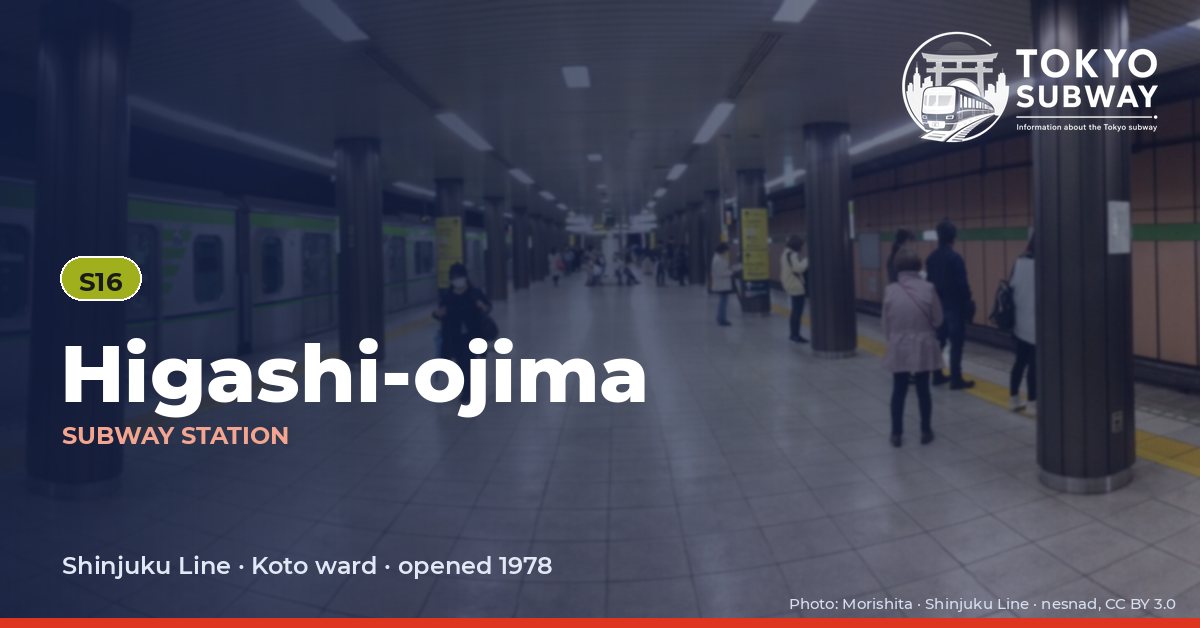
Higashi-ojima is a station built as a bridge. Its two side platforms span the Kyu-Naka river on a series of spans, with one entrance on the Koto bank and the other in Edogawa, so the ward boundary runs through the station – there is a marker on the platform showing where. That oddity earned it a place among the hundred selected stations of the Kanto region in 2000.
It opened on 21 December 1978 as the end of the Shinjuku Line and became an intermediate stop on 23 December 1983 when the line was extended to Funabori. The ground here lies below sea level, so the structure was set above A.P. +3.5 m against flooding and the platforms stand about 12 m above the water. The whole station sits on a curve of 600 m radius, which is why a member of staff is posted on the platform through most of the day. Toei has used it as a test bed for solar and wind power, rainwater collection and rooftop planting; mist sprayers cooled the platform each summer until 2016, and air-conditioned waiting rooms replaced them in June 2018. The 2024 count was 30,424 entries and exits a day.
Finding Higashi-ojima on the signs
Every line gives the station its own letter-and-number code. You never have to read the Japanese name to find the right platform.
Station numbers at Higashi-ojima
Tokyo signposts every platform, exit and train door with a letter and a two-digit number. Matching the number is faster than reading the name — and it is what you will see on the map, in announcements and on the platform edge.
First and last trains at Higashi-ojima
| Line and direction | Weekdays first – last | Saturdays, Sundays & holidays first – last |
|---|---|---|
| SShinjukuS16 towards Motoyawata | 05:04 – 00:15 to Mizue | 05:04 – 00:15 to Mizue |
| SShinjukuS16 towards Shinjuku | 05:13 – 00:22 to Ojima | 05:13 – 00:22 to Ojima |
Departure times come from the operators’ own GTFS timetables (ODPT GTFS Toei-Train-GTFS (version 20261009, valid 2026-03-14..2027-03-12) + TokyoMetro-Train-GTFS (version 20261008, valid 2026-09-19..2027-03-12)). Japan publishes two subway timetables: 平日 weekdays and 土休日 Saturdays, Sundays and national holidays. There is no separate Sunday timetable, and the December 30 – January 3 period runs the holiday timetable.
How often do trains run?
| Line | Weekdays, busiest hour | Sat / Sun / holidays, busiest hour |
|---|---|---|
| SShinjuku | 15 trains/hour (about one every 4 min) | 11 trains/hour |
Departures in one direction during the hour with the most trains at this station, counted in the operators’ timetable.
Transfers and connections
Only the Shinjuku Line stops here, and no other railway serves this station, so there is nothing to transfer to inside the station.
Accessibility
| Line | Step-free by elevator | Accessible toilet | Escalator | Exits |
|---|---|---|---|---|
| SShinjuku | Yes | Yes | Yes | 2 |
- Shinjuku Line: Toei: step-free “1-route” secured; 5 elevator(s) on this line. Elevator exit(s): 要翻訳, 要翻訳. Operator page (checked Oct 20, 2026).
Taken from the operators’ own accessibility pages and nothing else. Toei: every station has elevators and a street-gate-platform “1-route” is secured.
What is near Higashi-ojima Station?
Parks fill both banks: Ojima-Komatsugawa Park starts about 180 m from the exits, with its sports grounds and seasonal gardens spread along the water, and the Arakawa lock gate is a short walk beyond. The Nakagawa Funebansho Museum, on the site of an Edo-period river checkpoint, is roughly 280 m away, and the Kyu-Nakagawa river station museum about the same. Higashi Ojima Library stands some 190 m from the gates, with the Tokyo Joto hospital and a large housing estate among the other places the station serves.
| Place | Distance (straight line) | On foot, estimated |
|---|---|---|
| Nakagawa Funebansho Museum 江東区中川船番所資料館 | 280 m | about 4 min |
| Sport Square Garden, Ojima Komatsugawa Park 大島小松川公園 スポーツ広場 | 260 m | about 4 min |
| Kyu-nakagawa Kawa-no-eki 旧中川・川の駅 | 280 m | about 5 min |
| 大島小松川公園 | 180 m | about 3 min |
| 都立大島小松川公園スポーツ広場 | 200 m | about 3 min |
| 大島小松川公園(季節の広場) | 290 m | about 5 min |
| 大島東公園 | 320 m | about 5 min |
| 江東区立 第三大島小学校 | 320 m | about 5 min |
Places from OpenStreetMap within 400 m of the station. The walking time is an estimate (straight line plus 30 %, 80 m a minute), not a measured route. © OpenStreetMap contributors, ODbL.