
Hikarigaoka Station
E38 · Oedo Line · Nerima
Hikarigaoka Station (光が丘)
The Oedo Line ends here, at the westernmost station Toei operates, and it ends shallow: the platform lies 11.9 m below the surface, the least deep on a line better known for burrowing. E38 opened on 10 December 1991, when this was still Line 12, and was planned on a larger scale than it was built – two island platforms and four tracks for ten-car trains, cut back to a single island with two tracks before construction.
Beyond the platform the tracks split into two sidings that trains use to turn back, and those sidings carry on into the Takamatsu depot. The running lines themselves were built for a longer railway: the westbound track was constructed as far as a point where it dips beneath the depot approach on a 1-in-29 gradient, ready for an extension toward Oizumi that a 2016 transport council report recommended and that has not been built. Platform doors came into use on 8 December 2012. Toei counted 56,838 entries and exits a day in 2024, second among Oedo Line stations that meet no other railway.
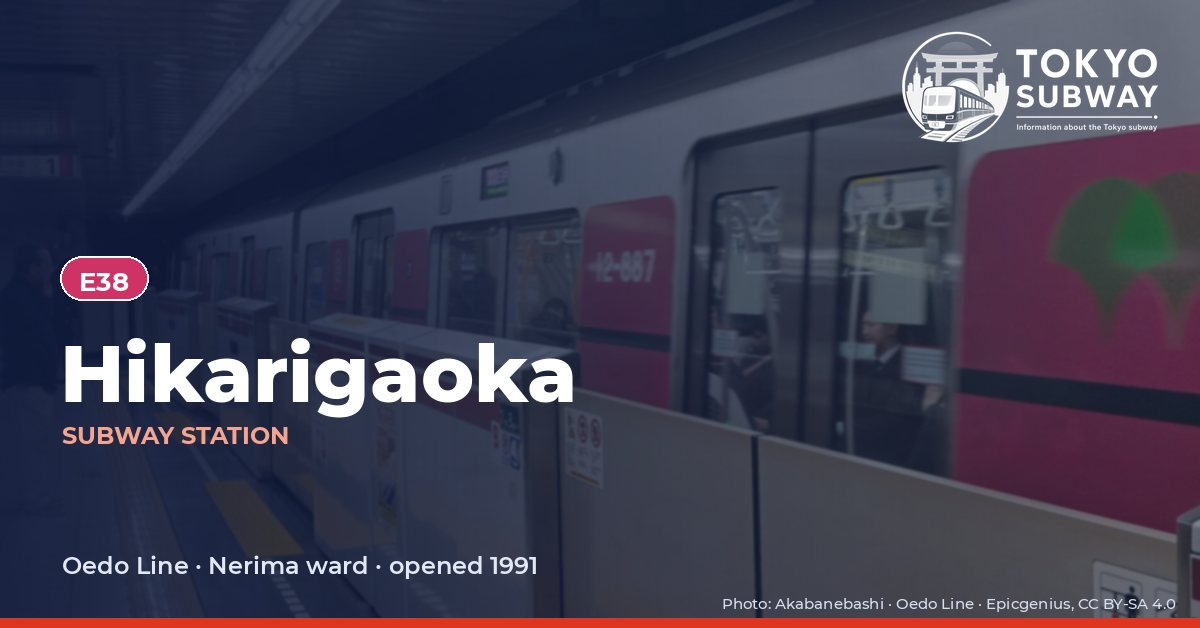
Finding Hikarigaoka on the signs
Every line gives the station its own letter-and-number code. You never have to read the Japanese name to find the right platform.
Station numbers at Hikarigaoka
Tokyo signposts every platform, exit and train door with a letter and a two-digit number. Matching the number is faster than reading the name — and it is what you will see on the map, in announcements and on the platform edge.
First and last trains at Hikarigaoka
| Line and direction | Weekdays first – last | Saturdays, Sundays & holidays first – last |
|---|---|---|
| EOedoE38 towards Tochomae | 05:00 – 00:17 | 05:00 – 00:17 |
Departure times come from the operators’ own GTFS timetables (ODPT GTFS Toei-Train-GTFS (version 20261009, valid 2026-03-14..2027-03-12) + TokyoMetro-Train-GTFS (version 20261008, valid 2026-09-19..2027-03-12)). Japan publishes two subway timetables: 平日 weekdays and 土休日 Saturdays, Sundays and national holidays. There is no separate Sunday timetable, and the December 30 – January 3 period runs the holiday timetable.
How often do trains run?
| Line | Weekdays, busiest hour | Sat / Sun / holidays, busiest hour |
|---|---|---|
| EOedo | 18 trains/hour (about one every 3.3 min) | 13 trains/hour |
Departures in one direction during the hour with the most trains at this station, counted in the operators’ timetable.
Next stations from Hikarigaoka
Scheduled running time between Hikarigaoka and the stations either side of it.
| Line | Next station | Running time |
|---|---|---|
| EOedo | E37Nerima-kasugacho | 2 min |
Transfers and connections
Only the Oedo Line stops here, and no other railway serves this station, so there is nothing to transfer to inside the station.
Accessibility
| Line | Step-free by elevator | Accessible toilet | Escalator | Exits |
|---|---|---|---|---|
| EOedo | Yes | Yes | Yes | 5 |
- Oedo Line: Toei: step-free “1-route” secured; 2 elevator(s) on this line. Elevator exit(s): A2, A3, A5. Operator page (checked Oct 20, 2026).
Taken from the operators’ own accessibility pages and nothing else. Toei: every station has elevators and a street-gate-platform “1-route” is secured.
What is near Hikarigaoka Station?
The station sits on the central axis of the Hikarigaoka housing estate, with an exit opening directly into the Hikarigaoka IMA shopping centre about 120 m away and another into the Nerima ward branch office. Hikarigaoka Park and the gardens laid out in Spanish, French and Italian styles are a few minutes from the gates, with the Shiki-no-Kaori rose garden around 350 m and the Hikarigaoka Art Museum about 340 m. The post office, police station and ward library are all within the same short radius, and bus routes radiate from the forecourt toward Nerima, Narimasu and Ikebukuro.
| Place | Distance (straight line) | On foot, estimated |
|---|---|---|
| 夏の雲公園 | 280 m | about 5 min |
| Hikarigaoka Art Museum 光が丘美術館 | 340 m | about 5 min |
| 光が丘LIVIN, IMA, イオン | 120 m | about 2 min |
| モノリス公園 | 190 m | about 3 min |
| 光が丘大通り 緑地 | 200 m | about 3 min |
| タワー公園 | 250 m | about 4 min |
| ryokufuu park | 290 m | about 5 min |
| スペイン式庭園 | 310 m | about 5 min |
Places from OpenStreetMap within 400 m of the station. The walking time is an estimate (straight line plus 30 %, 80 m a minute), not a measured route. © OpenStreetMap contributors, ODbL.