
Shimo Station
N18 · Namboku Line · Kita
Shimo Station (志茂)
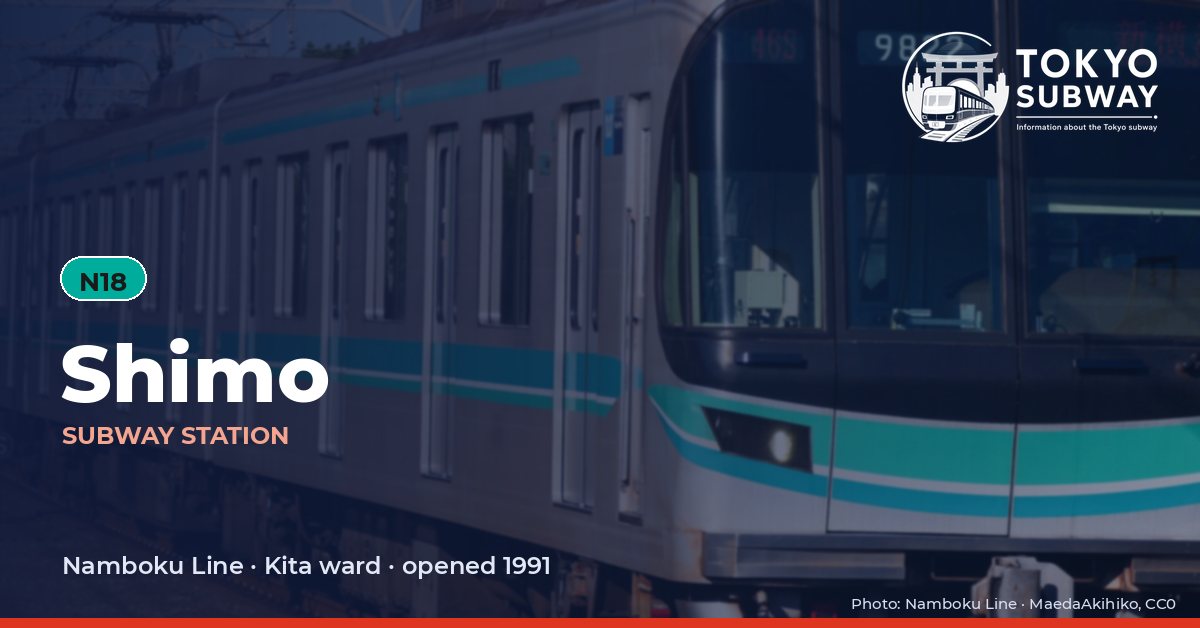
Shimo is one of the quietest places on the Tokyo Metro network: 16,136 passengers a day in 2025, third from the bottom among the company’s stations. It opened with the first section of the Namboku Line on 29 November 1991 and has changed little since, beyond a new departure melody in 2015 and the handover to a contracted operator in 2002.
A single island platform sits on the second basement level, 20.1 km from the line’s southern end at Meguro, behind the full-height platform screen doors the Namboku Line uses. Most people on board at N18 are passing through rather than getting off, because Namboku Line services continue past both ends of the subway — onto Saitama Rapid Railway metals in one direction, Tokyu and Sotetsu in the other — and the destination boards point far beyond Kita City.
Finding Shimo on the signs
Every line gives the station its own letter-and-number code. You never have to read the Japanese name to find the right platform.
Station numbers at Shimo
Tokyo signposts every platform, exit and train door with a letter and a two-digit number. Matching the number is faster than reading the name — and it is what you will see on the map, in announcements and on the platform edge.
First and last trains at Shimo
| Line and direction | Weekdays first – last | Saturdays, Sundays & holidays first – last |
|---|---|---|
| NNambokuN18 towards Akabane-iwabuchi | 05:11 – 00:36 | 05:11 – 00:27 |
| NNambokuN18 towards Meguro | 05:03 – 00:28 to Komagome | 05:03 – 00:18 to Komagome |
Departure times come from the operators’ own GTFS timetables (ODPT GTFS Toei-Train-GTFS (version 20261009, valid 2026-03-14..2027-03-12) + TokyoMetro-Train-GTFS (version 20261008, valid 2026-09-19..2027-03-12)). Japan publishes two subway timetables: 平日 weekdays and 土休日 Saturdays, Sundays and national holidays. There is no separate Sunday timetable, and the December 30 – January 3 period runs the holiday timetable.
How often do trains run?
| Line | Weekdays, busiest hour | Sat / Sun / holidays, busiest hour |
|---|---|---|
| NNamboku | 15 trains/hour (about one every 4 min) | 12 trains/hour |
Departures in one direction during the hour with the most trains at this station, counted in the operators’ timetable.
Next stations from Shimo
Scheduled running time between Shimo and the stations either side of it.
| Line | Next station | Running time |
|---|---|---|
| NNamboku | N19Akabane-iwabuchi | 2 min |
| NNamboku | N17Oji-kamiya | 3 min |
Transfers and connections
Only the Namboku Line stops here, and no other railway serves this station, so there is nothing to transfer to inside the station.
Accessibility
| Line | Step-free by elevator | Accessible toilet | Escalator | Exits |
|---|---|---|---|---|
| NNamboku | Yes | Yes | Yes | 2 |
- Namboku Line: Step-free elevator route street-gate-platform (official “1-route by elevator”). Street elevator at exit(s): 1. Operator page (checked Oct 20, 2026).
Taken from the operators’ own accessibility pages and nothing else. Tokyo Metro: the “1-route” (step-free street-gate-platform path by elevator, slope, stair lift or wheelchair escalator) is complete at all 180 stations; a separate list shows stations with an elevator-only 1-route.
What is near Shimo Station?
There is very little at street level. An elementary school stands about 110 m from the exits, a small park about 320 m away, and National Route 122 runs past. The rest is ordinary housing, with the ward’s sports halls, a large supermarket and the Akabane police station among the places the station serves. Nothing here is aimed at visitors, and the station is sized to match, with two exits.
| Place | Distance (straight line) | On foot, estimated |
|---|---|---|
| 志茂東公園 | 320 m | about 5 min |
| Nadeshiko Elementary School 北区立なでしこ小学校 | 110 m | about 2 min |
Places from OpenStreetMap within 400 m of the station. The walking time is an estimate (straight line plus 30 %, 80 m a minute), not a measured route. © OpenStreetMap contributors, ODbL.
Frequently asked questions
Hardly at all by Tokyo standards. Tokyo Metro’s 2025 survey recorded 16,136 passengers a day, which puts it third from the bottom of the company’s stations. One island platform and two exits are enough for the traffic it sees.
Often not. Services continue past both ends of the Namboku Line, so a train waiting at this platform may be bound for the Saitama Rapid Railway, or for Tokyu and Sotetsu destinations beyond the far end of the line. Shimo itself is a local stop on a line most of whose traffic is going somewhere else.