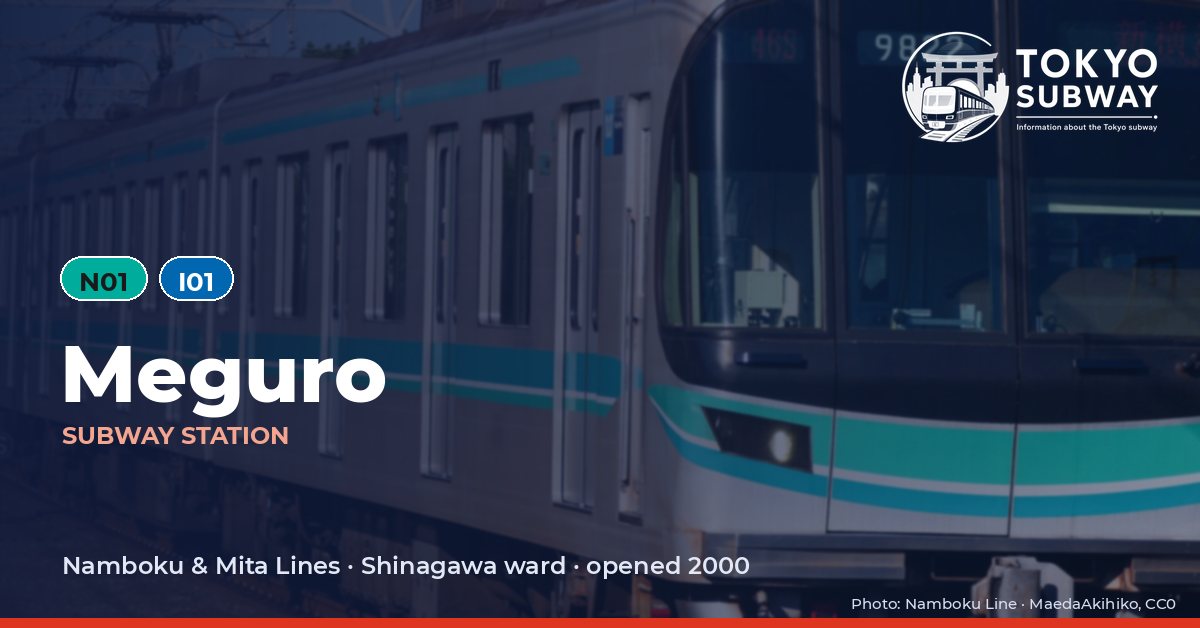
Meguro Station
N01 I01 · Namboku Line and Mita Line · Shinagawa
Meguro Station (目黒)
Meguro Station is not in Meguro. It stands in Kamiosaki in Shinagawa ward, just across the boundary from the ward it is named after, and it has carried trains since 16 March 1885, when Nippon Railway opened what is now JR East’s Yamanote Line platform. The subway did not follow until the next century: the Namboku Line and Toei’s Mita Line both opened here on 26 September 2000, and both chose it as their terminus, N01 and I01.
What they share is unusual. The two companies use the same island platform on the fourth basement level and the same pair of tracks as far as Shirokanedai and Shirokane-takanawa, so a passenger on that platform has to read the front of the train rather than the platform number. Neither line stops at Meguro in practice: almost everything runs through onto the Tokyu Meguro Line, and from there Namboku services reach Saitama Railway, Tokyu and Sotetsu tracks, with Mita Line trains going to Tokyu and Sotetsu as well.
Finding Meguro on the signs
Every line gives the station its own letter-and-number code. You never have to read the Japanese name to find the right platform.
Station numbers at Meguro
Tokyo signposts every platform, exit and train door with a letter and a two-digit number. Matching the number is faster than reading the name — and it is what you will see on the map, in announcements and on the platform edge.
First and last trains at Meguro
| Line and direction | Weekdays first – last | Saturdays, Sundays & holidays first – last |
|---|---|---|
| NNambokuN01 towards Akabane-iwabuchi | 05:16 – 23:59 | 05:16 – 23:59 to Komagome |
| IMitaI01 towards Nishi-takashimadaira | 05:12 – 23:55 to Takashimadaira | 05:12 – 23:54 to Takashimadaira |
Departure times come from the operators’ own GTFS timetables (ODPT GTFS Toei-Train-GTFS (version 20261009, valid 2026-03-14..2027-03-12) + TokyoMetro-Train-GTFS (version 20261008, valid 2026-09-19..2027-03-12)). Japan publishes two subway timetables: 平日 weekdays and 土休日 Saturdays, Sundays and national holidays. There is no separate Sunday timetable, and the December 30 – January 3 period runs the holiday timetable.
How often do trains run?
Departures in one direction during the hour with the most trains at this station, counted in the operators’ timetable.
Next stations from Meguro
Scheduled running time between Meguro and the stations either side of it.
| Line | Next station | Running time |
|---|---|---|
| NNamboku | N02Shirokanedai | 2 min |
| IMita | I02Shirokanedai | 2 min |
Transfers and connections
- Subway: transfer between Namboku Line and Mita Line. The Tokyo Metro lines and the Toei Subway lines belong to different companies, so a trip that uses both costs more than one operator alone — see fares.
- JR: Yamanote Line (JR East). These are separate railways with their own fares.
- Private railways: Meguro Line (Tokyu Railways). These are separate railways with their own fares.
Accessibility
- Namboku Line: Step-free elevator route street-gate-platform (official “1-route by elevator”). Operator page (checked Oct 20, 2026).
- Mita Line: Toei: step-free “1-route” secured; 2 elevator(s) on this line. Elevator exit(s): 要翻訳. Operator page (checked Oct 20, 2026).
Taken from the operators’ own accessibility pages and nothing else. Tokyo Metro: the “1-route” (step-free street-gate-platform path by elevator, slope, stair lift or wheelchair escalator) is complete at all 180 stations; a separate list shows stations with an elevator-only 1-route. Toei: every station has elevators and a street-gate-platform “1-route” is secured.
What is near Meguro Station?
The station exits into a steep-sided part of Shinagawa where shopping is vertical: the two Atré Meguro buildings stand 120–160 m away, over the tracks. Daienji temple is about 170 m from the gates, the Kume Museum of Art roughly 180 m and the Bicycle Culture Center around 220 m; the Sugino Costume Museum and the Sugino fashion college campus sit about 230–260 m out, and the Kita Roppeita XIV Memorial Noh Theater some 330 m.
| Place | Distance (straight line) | On foot, estimated |
|---|---|---|
| Daienji 大圓寺 | 170 m | about 3 min |
| Kume Museum of Art 久米美術館 | 180 m | about 3 min |
| 杉野服飾大学 | 160 m | about 3 min |
| Atré Meguro 1 Pavilion A アトレ目黒1 A館 | 120 m | about 2 min |
| Atré Meguro 1 Pavilion B アトレ目黒1 B館 | 160 m | about 3 min |
| Bicycle Culture Center 自転車文化センター | 220 m | about 4 min |
| Sugino Costume Museum 杉野学園衣裳博物館 | 260 m | about 4 min |
| Kita Roppeita XIV Commemorative Nogaku Theater 十四世喜多六平太記念能楽堂 | 330 m | about 5 min |
Places from OpenStreetMap within 400 m of the station. The walking time is an estimate (straight line plus 30 %, 80 m a minute), not a measured route. © OpenStreetMap contributors, ODbL.
Frequently asked questions
No. The station is in the Kamiosaki district of Shinagawa ward, close to the boundary with Meguro. The name comes from the area it faces rather than from the ward the ticket gates stand in.
Because the Namboku and Mita lines share tracks between Meguro and Shirokane-takanawa, including the island platform on the fourth basement level. Both lines end here on paper, and most trains continue onto the Tokyu Meguro Line, so check the destination and the line symbol rather than the platform.