
Nishigahara Station
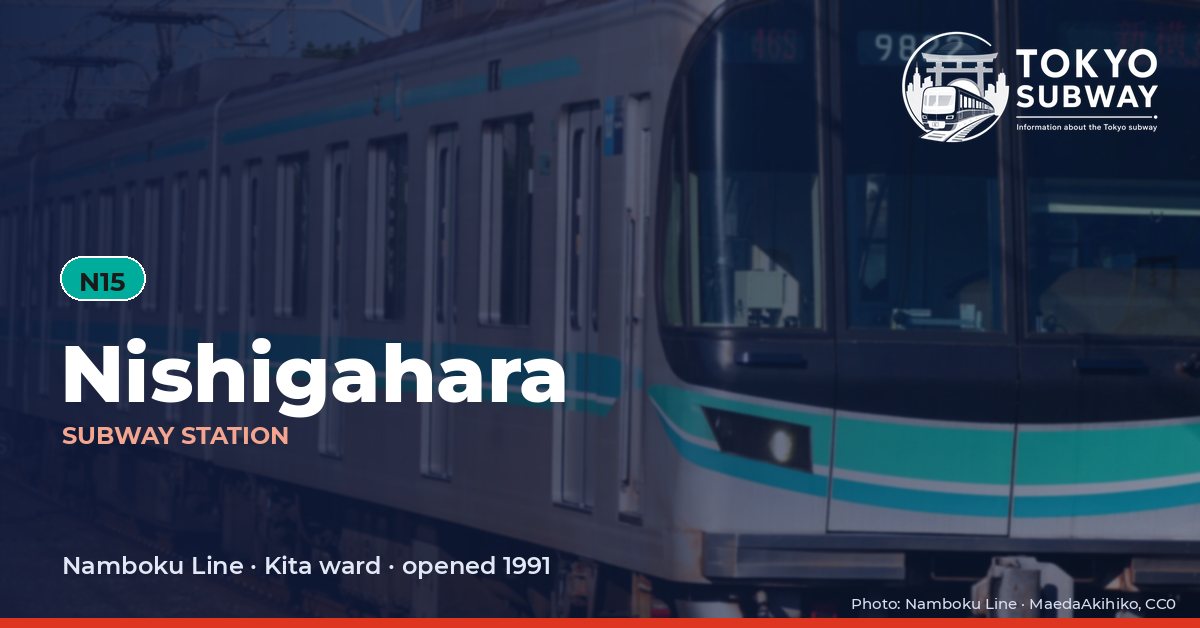
N15 · Namboku Line · Kita
Nishigahara Station (西ケ原)
Before anything could be built here, archaeologists had to finish. The ground along this part of the Namboku Line is registered as an area of buried cultural property, so excavation ran from 17 February 1986 to 9 October 1987 in five zones and turned up a substantial quantity of Jomon and Yayoi period remains. N15 opened on 29 November 1991, an island platform with two tracks and, later, platform doors.
What Nishigahara is known for now is emptiness. Tokyo Metro recorded 9,014 entries and exits a day here in its 2025 survey, which keeps it the least used station on the whole network and the only one that averages fewer than 10,000 people. The reasons are visible above ground: Komagome and Oji are close on either side, both with JR connections, and the quarter between them is low-rise and quiet.
Finding Nishigahara on the signs
Every line gives the station its own letter-and-number code. You never have to read the Japanese name to find the right platform.
Station numbers at Nishigahara
Tokyo signposts every platform, exit and train door with a letter and a two-digit number. Matching the number is faster than reading the name — and it is what you will see on the map, in announcements and on the platform edge.
First and last trains at Nishigahara
| Line and direction | Weekdays first – last | Saturdays, Sundays & holidays first – last |
|---|---|---|
| NNambokuN15 towards Akabane-iwabuchi | 05:17 – 00:30 | 05:17 – 00:21 |
| NNambokuN15 towards Meguro | 05:09 – 00:35 to Komagome | 05:09 – 00:24 to Komagome |
Departure times come from the operators’ own GTFS timetables (ODPT GTFS Toei-Train-GTFS (version 20261009, valid 2026-03-14..2027-03-12) + TokyoMetro-Train-GTFS (version 20261008, valid 2026-09-19..2027-03-12)). Japan publishes two subway timetables: 平日 weekdays and 土休日 Saturdays, Sundays and national holidays. There is no separate Sunday timetable, and the December 30 – January 3 period runs the holiday timetable.
How often do trains run?
| Line | Weekdays, busiest hour | Sat / Sun / holidays, busiest hour |
|---|---|---|
| NNamboku | 17 trains/hour (about one every 3.5 min) | 13 trains/hour |
Departures in one direction during the hour with the most trains at this station, counted in the operators’ timetable.
Transfers and connections
Only the Namboku Line stops here, and no other railway serves this station, so there is nothing to transfer to inside the station.
Accessibility
| Line | Step-free by elevator | Accessible toilet | Escalator | Exits |
|---|---|---|---|---|
| NNamboku | Yes | Yes | Yes | 2 |
- Namboku Line: Step-free elevator route street-gate-platform (official “1-route by elevator”). Street elevator at exit(s): 1. Operator page (checked Oct 20, 2026).
Taken from the operators’ own accessibility pages and nothing else. Tokyo Metro: the “1-route” (step-free street-gate-platform path by elevator, slope, stair lift or wheelchair escalator) is complete at all 180 stations; a separate list shows stations with an elevator-only 1-route.
What is near Nishigahara Station?
Kyu-Furukawa Gardens is the one destination people walk to from here. Otherwise the surroundings are local: Takinogawa Park about 180 m from the exits, the Takinogawa police station roughly 160 m, the Nishigahara boundary stone around 180 m and the Tokyo Goethe Memorial Library some 240 m, with Fudo-in, Shourin-ji, Hiratsuka shrine and Muryoji spread between 300 m and 390 m.
| Place | Distance (straight line) | On foot, estimated |
|---|---|---|
| Fudo-in Temple 不動院 | 300 m | about 5 min |
| Shourin-ji Temple 昌林寺 | 320 m | about 5 min |
| Hiratsuka-jinja Shrine 平塚神社 | 350 m | about 6 min |
| Muryoji Temple 西光院無量寺 | 390 m | about 6 min |
| Takinogawa Park 滝野川公園 | 180 m | about 3 min |
| 西ヶ原三丁目児童遊園 | 160 m | about 3 min |
| 谷戸さんさん児童遊園 | 380 m | about 6 min |
| 西ヶ原三丁目南ポケットパーク | 400 m | about 6 min |
Places from OpenStreetMap within 400 m of the station. The walking time is an estimate (straight line plus 30 %, 80 m a minute), not a measured route. © OpenStreetMap contributors, ODbL.
Frequently asked questions
Yes. With 9,014 entries and exits a day in the 2025 survey it is the least used station on the network, and the only one whose daily average stays below 10,000 — unusual for a station in the middle of a built-up ward.
Jomon and Yayoi period remains. The site lies in a registered buried cultural property area, so an excavation was carried out in five zones between February 1986 and October 1987, producing a large number of finds before construction of the Namboku Line station could begin.