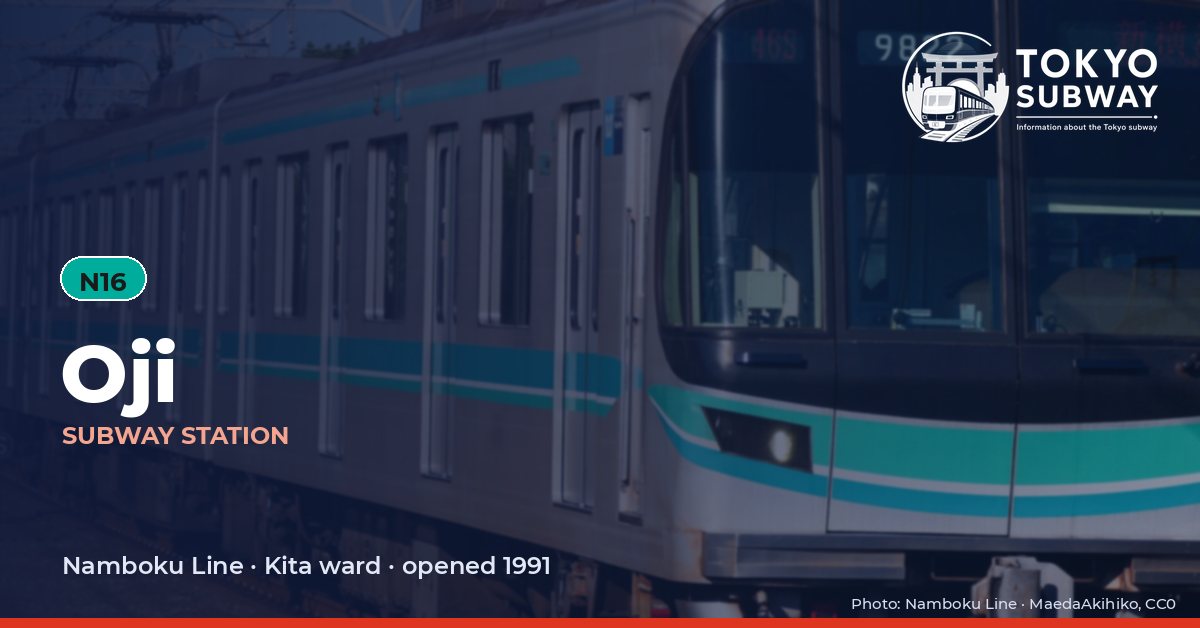
Oji Station
N16 · Namboku Line · Kita
Oji Station (王子)
Three railways meet at Oji without ever sharing a roof. The oldest is the surface station of 28 July 1883, among the first on what became the Tohoku Main Line and today a Keihin-Tohoku Line stop; the streetcar that is now the Tokyo Sakura Tram began running in 1915; and the subway came last, on 29 November 1991, when the Namboku Line opened with N16 here.
The tram stop keeps a name of its own, Oji-ekimae, and belongs to Toei rather than to Tokyo Metro, so three operators share the junction. Namboku Line trains rarely stay underground for long: services run through onto the Saitama Rapid Railway at one end of the line and onto Tokyu and Sotetsu tracks at the other, so a train standing at the platform may be bound for somewhere well outside the subway map. Tokyo Metro’s 2025 survey recorded 62,460 passengers a day.
Finding Oji on the signs
Every line gives the station its own letter-and-number code. You never have to read the Japanese name to find the right platform.
Station numbers at Oji
Tokyo signposts every platform, exit and train door with a letter and a two-digit number. Matching the number is faster than reading the name — and it is what you will see on the map, in announcements and on the platform edge.
First and last trains at Oji
| Line and direction | Weekdays first – last | Saturdays, Sundays & holidays first – last |
|---|---|---|
| NNambokuN16 towards Akabane-iwabuchi | 05:19 – 00:32 | 05:19 – 00:23 |
| NNambokuN16 towards Meguro | 05:07 – 00:33 to Komagome | 05:07 – 00:22 to Komagome |
Departure times come from the operators’ own GTFS timetables (ODPT GTFS Toei-Train-GTFS (version 20261009, valid 2026-03-14..2027-03-12) + TokyoMetro-Train-GTFS (version 20261008, valid 2026-09-19..2027-03-12)). Japan publishes two subway timetables: 平日 weekdays and 土休日 Saturdays, Sundays and national holidays. There is no separate Sunday timetable, and the December 30 – January 3 period runs the holiday timetable.
How often do trains run?
| Line | Weekdays, busiest hour | Sat / Sun / holidays, busiest hour |
|---|---|---|
| NNamboku | 18 trains/hour (about one every 3.3 min) | 12 trains/hour |
Departures in one direction during the hour with the most trains at this station, counted in the operators’ timetable.
Next stations from Oji
Scheduled running time between Oji and the stations either side of it.
| Line | Next station | Running time |
|---|---|---|
| NNamboku | N15Nishigahara | 2 min |
| NNamboku | N17Oji-kamiya | 2 min |
Transfers and connections
- JR: Keihin-Tohoku-Negishi Line (JR East). These are separate railways with their own fares.
- Tram: Tokyo Sakura Tram (Arakawa Line) (Tokyo Metropolitan Bureau of Transportation). These are separate railways with their own fares.
Accessibility
| Line | Step-free by elevator | Accessible toilet | Escalator | Exits |
|---|---|---|---|---|
| NNamboku | Yes | Yes | Yes | 5 |
- Namboku Line: Step-free elevator route street-gate-platform (official “1-route by elevator”). Street elevator at exit(s): 5. Operator page (checked Oct 20, 2026).
Taken from the operators’ own accessibility pages and nothing else. Tokyo Metro: the “1-route” (step-free street-gate-platform path by elevator, slope, stair lift or wheelchair escalator) is complete at all 180 stations; a separate list shows stations with an elevator-only 1-route.
What is near Oji Station?
Exits come up at a road junction ringed with civic buildings: the Kita City Office about 300 m away and Hokutopia, the ward’s tall tower, barely 80 m. Oji Shrine stands about 190 m off, the Banknote and Postage Stamp Museum about 170 m, and the Otonashi Water Park about 240 m. The Peace Memorial Statue is right outside, roughly 70 m from the subway exits, and the JR station is close enough to be mapped as a landmark in its own right.
| Place | Distance (straight line) | On foot, estimated |
|---|---|---|
| Oji Shrine 王子神社 | 190 m | about 3 min |
| Peace Memorial Statue 平和記念像 | 70 m | about 1 min |
| Hokutopia 北とぴあ | 80 m | about 1 min |
| independent theatre Oji インディペンデントシアターOji | 140 m | about 2 min |
| Banknote and Postage Stamp Museum お札と切手の博物館 | 170 m | about 3 min |
| Sun Square サンスクエア | 190 m | about 3 min |
| Yanagida Park 柳田公園 | 210 m | about 3 min |
| Oji Studio 1 王子スタジオ1 | 280 m | about 5 min |
Places from OpenStreetMap within 400 m of the station. The walking time is an estimate (straight line plus 30 %, 80 m a minute), not a measured route. © OpenStreetMap contributors, ODbL.
Frequently asked questions
Not quite. The Tokyo Sakura Tram, the old Arakawa Line, calls at a stop named Oji-ekimae rather than Oji, and Toei runs it, while the Namboku Line platforms belong to Tokyo Metro. The tram has served the spot since 1915, three-quarters of a century before the subway arrived.
The surface station opened on 28 July 1883 and is among the oldest on the line now known as the Tohoku Main Line, although only Keihin-Tohoku Line trains call there today. The Namboku Line platforms below are more than a century younger, dating from 29 November 1991.