
Shin-itabashi Station
I17 · Mita Line · Itabashi
Shin-itabashi Station (新板橋)
Shin-itabashi is defined by the stations around it. I17 is the easternmost station in Itabashi City, and close to its exits are two stations belonging to other companies — JR East’s Itabashi on the Saikyo Line and Tobu’s Shimo-Itabashi on the Tojo Line — neither of which shares its name. The Mita Line began announcing the JR connection when its onboard announcements were updated in 2018, although JR does not return the favour, and when either line is disrupted the two are paired for substitute travel.
The station opened on 27 December 1968 with the first section of Toei Line 6, renamed the Mita Line in 1978, and has a single island platform. A siding towards Nishi-takashimadaira holds a train overnight, and it forms the first departure of the morning towards Shirokane-takanawa; the same siding lets trains turn back here when something goes wrong further down the line. Toei counted 29,972 passengers a day in 2024.
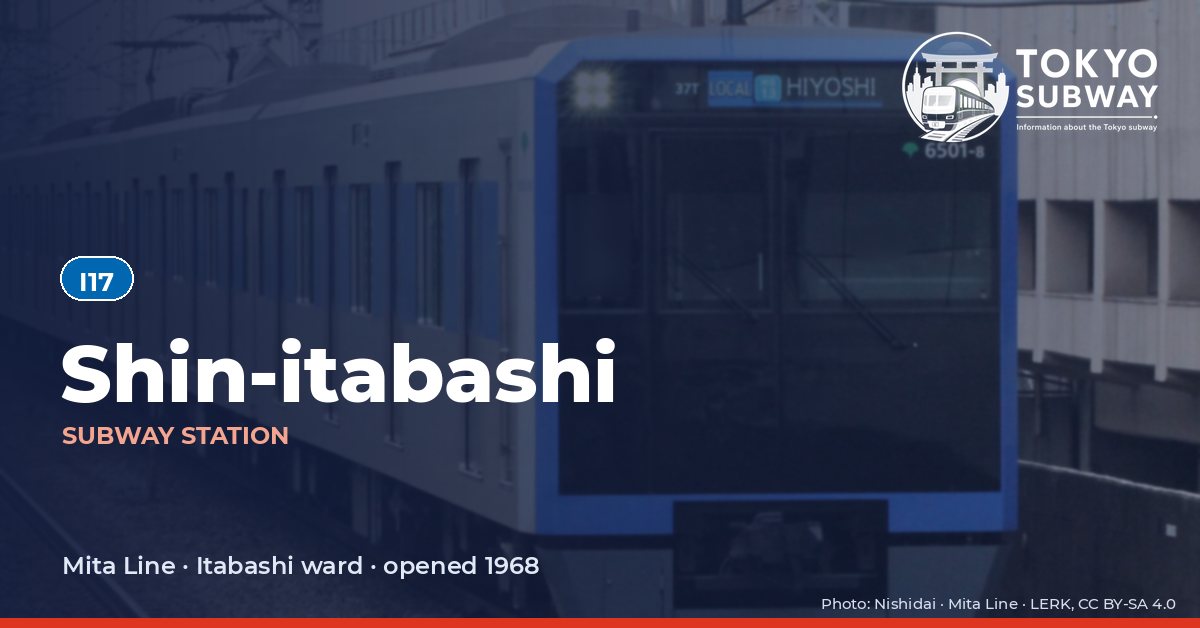
Finding Shin-itabashi on the signs
Every line gives the station its own letter-and-number code. You never have to read the Japanese name to find the right platform.
Station numbers at Shin-itabashi
Tokyo signposts every platform, exit and train door with a letter and a two-digit number. Matching the number is faster than reading the name — and it is what you will see on the map, in announcements and on the platform edge.
First and last trains at Shin-itabashi
| Line and direction | Weekdays first – last | Saturdays, Sundays & holidays first – last |
|---|---|---|
| IMitaI17 towards Nishi-takashimadaira | 05:28 – 00:29 to Takashimadaira | 05:28 – 00:29 to Takashimadaira |
| IMitaI17 towards Meguro | 05:00 to Shirokane-takanawa – 00:04 to Shirokane-takanawa | 05:00 to Shirokane-takanawa – 00:04 to Shirokane-takanawa |
Departure times come from the operators’ own GTFS timetables (ODPT GTFS Toei-Train-GTFS (version 20261009, valid 2026-03-14..2027-03-12) + TokyoMetro-Train-GTFS (version 20261008, valid 2026-09-19..2027-03-12)). Japan publishes two subway timetables: 平日 weekdays and 土休日 Saturdays, Sundays and national holidays. There is no separate Sunday timetable, and the December 30 – January 3 period runs the holiday timetable.
How often do trains run?
| Line | Weekdays, busiest hour | Sat / Sun / holidays, busiest hour |
|---|---|---|
| IMita | 19 trains/hour (about one every 3.2 min) | 11 trains/hour |
Departures in one direction during the hour with the most trains at this station, counted in the operators’ timetable.
Next stations from Shin-itabashi
Scheduled running time between Shin-itabashi and the stations either side of it.
| Line | Next station | Running time |
|---|---|---|
| IMita | I18Itabashi-kuyakushomae | 1 min |
| IMita | I16Nishi-sugamo | 1 min |
Transfers and connections
- JR: Saikyo-Kawagoe Line (JR East). These are separate railways with their own fares.
Accessibility
| Line | Step-free by elevator | Accessible toilet | Escalator | Exits |
|---|---|---|---|---|
| IMita | Yes | Yes | Yes | 3 |
- Mita Line: Toei: step-free “1-route” secured; 2 elevator(s) on this line. Operator page (checked Oct 20, 2026).
Taken from the operators’ own accessibility pages and nothing else. Toei: every station has elevators and a street-gate-platform “1-route” is secured.
What is near Shin-itabashi Station?
Route 17 and the Chuo Circular Expressway run directly above the platforms, which sets the tone: this is a corridor more than a destination. Small parks do what they can — Itabashi 4-chome east park about 120 m away, the park outside Itabashi Station about 220 m, the Otonashi Kunugi green strip about 350 m. The Lycée Français International de Tokyo, which moved to Takinogawa in 2012, is among the places the station serves, and a monument roughly 370 m away marks the place of Kondo Isami’s death.
| Place | Distance (straight line) | On foot, estimated |
|---|---|---|
| KONDO Isami's demise site 近藤勇終焉の地 | 370 m | about 6 min |
| 板橋四丁目東公園 | 120 m | about 2 min |
| 板橋駅前公園 | 220 m | about 4 min |
| 板橋一丁目児童遊園 | 310 m | about 5 min |
| 音無くぬぎ緑地 | 350 m | about 6 min |
| 滝野川五丁目児童遊園 | 360 m | about 6 min |
| 板橋東いこいの森 | 370 m | about 6 min |
| Terrain de foot | 370 m | about 6 min |
Places from OpenStreetMap within 400 m of the station. The walking time is an estimate (straight line plus 30 %, 80 m a minute), not a measured route. © OpenStreetMap contributors, ODbL.
Frequently asked questions
Itabashi Station on the JR Saikyo Line is close to the A2 exit, and the Mita Line announces it as a connection, but JR does not list Shin-itabashi as a transfer and the route between them runs along the street rather than through a passage. Tobu’s Shimo-Itabashi is also nearby.
There is a siding beyond the platform towards Nishi-takashimadaira where a train is stabled. It forms the first service of the day towards Shirokane-takanawa, and the same siding is used to turn trains back at this station when the line is disrupted.