
Yoyogi Station
E26 · Oedo Line · Shibuya
Yoyogi Station (代々木)
The Oedo Line platform at Yoyogi, E26, opened on 20 April 2000, eight months before the rest of the line, and it is the junior partner here by almost a century. The railway station above it opened on 23 October 1906, built by a private company on the Chuo Main Line and taken into state hands a week later when the government bought the company out.
The two stations work as one in practice and not at all in law. The JR part has a side platform on each flank of an island, four tracks in all, and three ways out; the west and north exits are the ones that lead easily down to the subway. The Toei part is a single underground island platform with its own gates. One of the street entrances is closed. In 2024 the Toei station was used by 32,870 people on an average day, a figure still short of the 38,284 it carried in 2019 and a reminder that a station this close to Shinjuku lives on office workers rather than visitors.
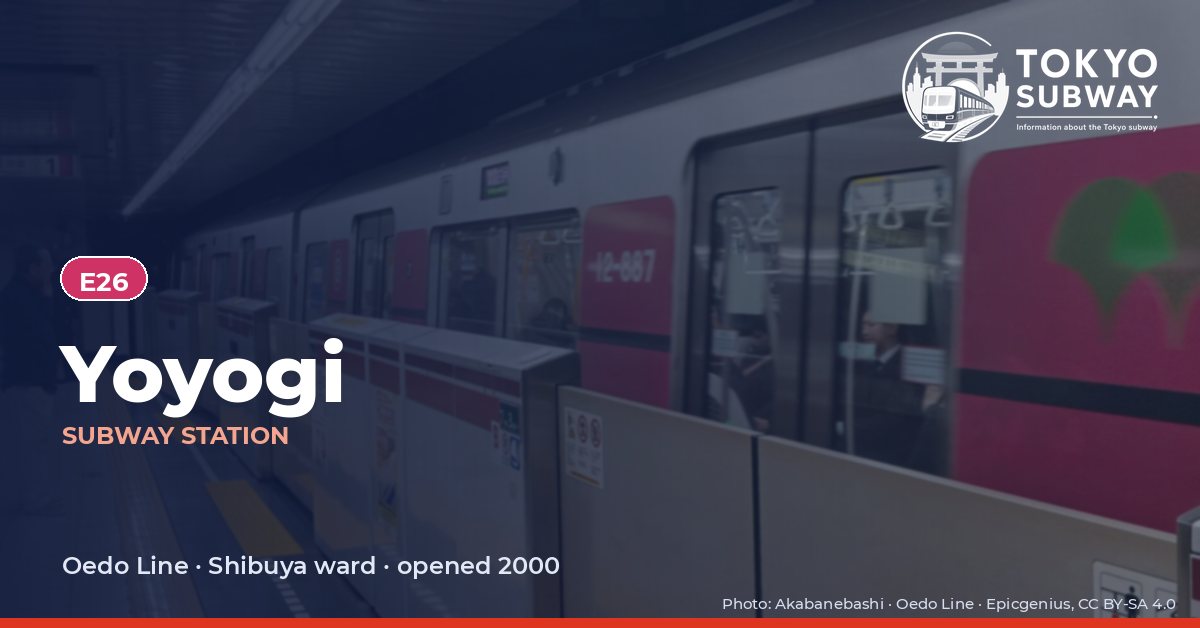
Finding Yoyogi on the signs
Every line gives the station its own letter-and-number code. You never have to read the Japanese name to find the right platform.
Station numbers at Yoyogi
Tokyo signposts every platform, exit and train door with a letter and a two-digit number. Matching the number is faster than reading the name — and it is what you will see on the map, in announcements and on the platform edge.
First and last trains at Yoyogi
Departure times come from the operators’ own GTFS timetables (ODPT GTFS Toei-Train-GTFS (version 20261009, valid 2026-03-14..2027-03-12) + TokyoMetro-Train-GTFS (version 20261008, valid 2026-09-19..2027-03-12)). Japan publishes two subway timetables: 平日 weekdays and 土休日 Saturdays, Sundays and national holidays. There is no separate Sunday timetable, and the December 30 – January 3 period runs the holiday timetable.
How often do trains run?
| Line | Weekdays, busiest hour | Sat / Sun / holidays, busiest hour |
|---|---|---|
| EOedo | 20 trains/hour (about one every 3 min) | 12 trains/hour |
Departures in one direction during the hour with the most trains at this station, counted in the operators’ timetable.
Next stations from Yoyogi
Scheduled running time between Yoyogi and the stations either side of it.
| Line | Next station | Running time |
|---|---|---|
| EOedo | E25Kokuritsu-kyogijo | 2 min |
| EOedo | E27Shinjuku | 1 min |
Transfers and connections
- JR: Chuo-Sobu Local Line (JR East), Yamanote Line (JR East). These are separate railways with their own fares.
Accessibility
| Line | Step-free by elevator | Accessible toilet | Escalator | Exits |
|---|---|---|---|---|
| EOedo | Yes | Yes | Yes | 2 |
- Oedo Line: Toei: step-free “1-route” secured; 2 elevator(s) on this line. Elevator exit(s): A3. Operator page (checked Oct 20, 2026).
Taken from the operators’ own accessibility pages and nothing else. Toei: every station has elevators and a street-gate-platform “1-route” is secured.
What is near Yoyogi Station?
Yoyogi sits in the gap between Shinjuku and Yoyogi Park, and the blocks above it are offices and cram schools rather than sights. The NTT Docomo Yoyogi building, the tower with the clock, is about 170 m from the exits; the Odakyu Southern Tower is about 350 m away and the JR Minami-Shinjuku building about 360 m. JR Tokyo General Hospital is about 290 m off and the Tokyo School of Business about 100 m. The Yoyogi Midori park is about 90 m from the station, and Kokuritsu-kyogijo is the next stop.
| Place | Distance (straight line) | On foot, estimated |
|---|---|---|
| Yoyogi Eki Stamp 代々木駅 駅スタンプ | 70 m | about 1 min |
| 代々木みどり公園 | 90 m | about 1 min |
| うまや道公園 | 240 m | about 4 min |
| Tokyo School of Business 東京スクールオブビジネス | 100 m | about 2 min |
| SoftBank Shop ソフトバンクショップ | 150 m | about 2 min |
| NTT Docomo Yoyogi Building ドコモ代々木タワー | 170 m | about 3 min |
| JR Tokyo General Hospital JR東京総合病院 | 290 m | about 5 min |
| Tully's Coffee タリーズコーヒー | 300 m | about 5 min |
Places from OpenStreetMap within 400 m of the station. The walking time is an estimate (straight line plus 30 %, 80 m a minute), not a measured route. © OpenStreetMap contributors, ODbL.
Frequently asked questions
They share a name and a site but not an operator. The JR station, with its Yamanote and Chuo-Sobu platforms at ground level, is run by JR East; the Oedo Line platform below is Toei. Each has its own ticket gates, and the west and north exits of the JR station are the ones that lead most directly to the subway.
It opened on 23 October 1906, built by a private company on the Chuo Main Line. A week later the government nationalized the company and took over the station with it. Platform numbering was added in 2016, by which time the Oedo Line had been running underneath for sixteen years.