
Ryogoku Station
E12 · Oedo Line · Sumida
Ryogoku Station (両国)
Sumo gives Ryogoku its reputation, but the subway part of the station is young: the Oedo Line opened E12 on 12 December 2000, almost a century after the railway above. That surface station began on 5 April 1904 as Ryogokubashi and took its present name in 1931. It kept a third platform at a slightly lower level from its days as a terminus, still used for occasional special trains, while rapid services pass the station through a tunnel.
The two halves count as an interchange but are run by different companies and share no gateline, so changing between JR East and Toei means going through two sets of ticket barriers rather than crossing a platform. The Toei station runs on a north–south axis beneath Kiyosumi-dori, with five exits labelled A1 to A5. Toei counted 34,318 passengers a day in 2024.
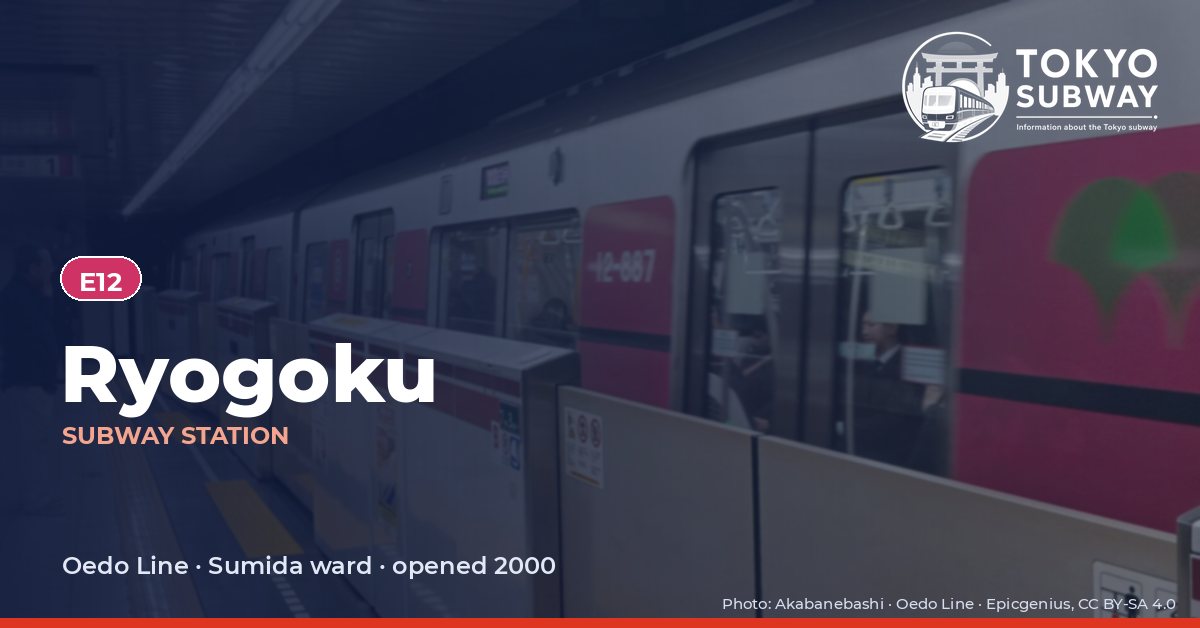
Finding Ryogoku on the signs
Every line gives the station its own letter-and-number code. You never have to read the Japanese name to find the right platform.
Station numbers at Ryogoku
Tokyo signposts every platform, exit and train door with a letter and a two-digit number. Matching the number is faster than reading the name — and it is what you will see on the map, in announcements and on the platform edge.
First and last trains at Ryogoku
Departure times come from the operators’ own GTFS timetables (ODPT GTFS Toei-Train-GTFS (version 20261009, valid 2026-03-14..2027-03-12) + TokyoMetro-Train-GTFS (version 20261008, valid 2026-09-19..2027-03-12)). Japan publishes two subway timetables: 平日 weekdays and 土休日 Saturdays, Sundays and national holidays. There is no separate Sunday timetable, and the December 30 – January 3 period runs the holiday timetable.
How often do trains run?
| Line | Weekdays, busiest hour | Sat / Sun / holidays, busiest hour |
|---|---|---|
| EOedo | 15 trains/hour (about one every 4 min) | 13 trains/hour |
Departures in one direction during the hour with the most trains at this station, counted in the operators’ timetable.
Transfers and connections
- JR: Chuo-Sobu Local Line (JR East). These are separate railways with their own fares.
Accessibility
| Line | Step-free by elevator | Accessible toilet | Escalator | Exits |
|---|---|---|---|---|
| EOedo | Yes | Yes | Yes | 5 |
- Oedo Line: Toei: step-free “1-route” secured; 3 elevator(s) on this line. Elevator exit(s): A3. Operator page (checked Oct 20, 2026).
Taken from the operators’ own accessibility pages and nothing else. Toei: every station has elevators and a street-gate-platform “1-route” is secured.
What is near Ryogoku Station?
Almost everything within a few hundred metres is a museum or a sumo address. The Edo-Tokyo Museum is about 120 m from the exits, the Sumida Hokusai Museum about 280 m, the Sumo Museum about 390 m and the Hakkaku stable barely 80 m. Yokoamicho Park, roughly 320 m away, holds the Great Kanto Earthquake Memorial Museum and a monument to the victims of the Tokyo air raids, with the Former Yasuda Gardens and Nomi Sukune Shrine at the far edge of the same walk. The Ryogoku Kokugikan is close by.
| Place | Distance (straight line) | On foot, estimated |
|---|---|---|
| Edo Tokyo Museum 江戸東京博物館 | 120 m | about 2 min |
| Sumida Hokusai Museum すみだ北斎美術館 | 280 m | about 5 min |
| Yokoamicho Park 都立横網町公園 | 320 m | about 5 min |
| Great Kanto Earthquake Memorial Museum 東京都復興記念館 | 340 m | about 6 min |
| Nomi Sukune Shrine 野見宿禰神社 | 350 m | about 6 min |
| Sumo Museum 相撲博物館 | 390 m | about 6 min |
| Former Yasuda Gardens 旧安田庭園 | 390 m | about 6 min |
| Midoricho Park 緑町公園 | 260 m | about 4 min |
Places from OpenStreetMap within 400 m of the station. The walking time is an estimate (straight line plus 30 %, 80 m a minute), not a measured route. © OpenStreetMap contributors, ODbL.
Frequently asked questions
They share a name and count as an interchange, but they are two stations run by two companies: JR East’s elevated platforms and Toei’s below Kiyosumi-dori. Changing between them means passing through two sets of ticket gates rather than walking from one platform to another.
Ryogoku was once a terminus, and platform 3, set slightly lower than the two in daily use, survives from that period. Regular Chuo-Sobu Line trains do not call there; it is kept for special services, while rapid trains bypass the station altogether through a tunnel to the north.