Omote-sando Station
G02 C04 Z02 · Ginza Line, Chiyoda Line, and Hanzomon Line · Minato
Omote-sando Station (表参道)
No other Tokyo Metro station has changed its name twice. Omote-sando opened on 18 November 1938 as Aoyama-rokuchome, the terminus of the Tokyo Rapid Railway’s line from Toranomon, on a site about 180 m from where the platforms stand now. A month later the extension to Shibuya made it a through station, and when through services from Asakusa began on 16 September 1939 it was renamed Jingumae. The present name arrived with the Chiyoda Line platforms on 20 October 1972, chosen so that it would not be mistaken for Meiji-Jingumae further along the same line.
For five years after that, Omotesando and Jingumae were two separate stations. The Ginza Line moved to a temporary platform in 1977, and the arrangement in use today — Ginza (G02) and Hanzomon (Z02) sharing two island platforms on B1, the ticket hall on B2 and the Chiyoda Line (C04) on B3 — opened on 1 August 1978. The abandoned Jingumae space is still visible from the Ginza Line tunnel.
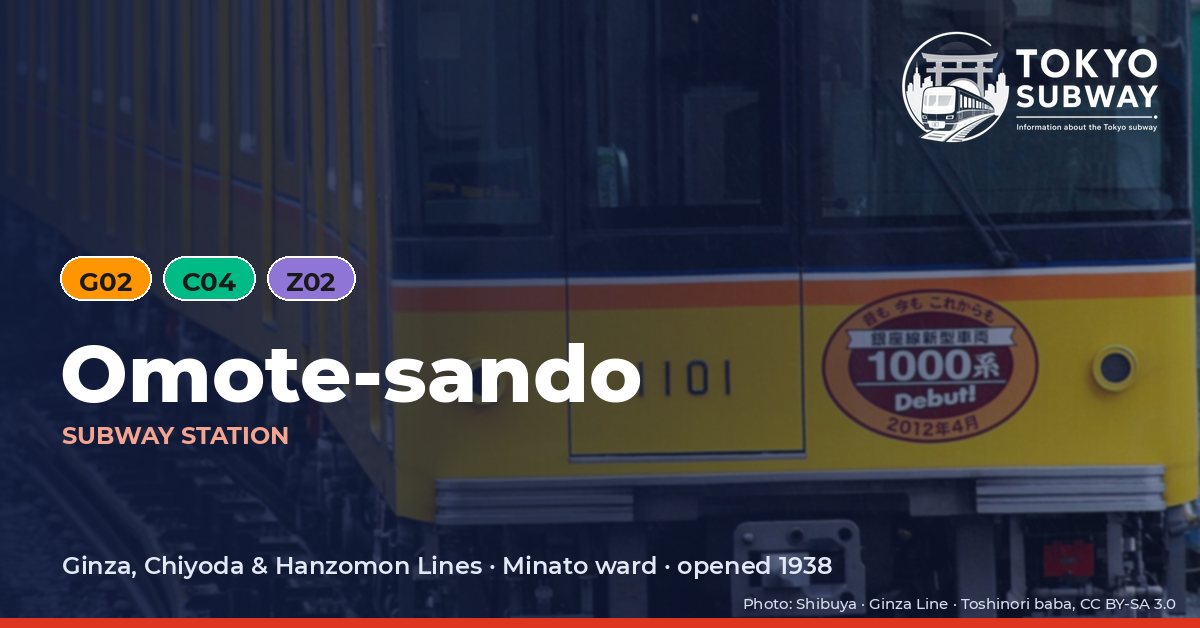
Finding Omote-sando on the signs
Every line gives the station its own letter-and-number code. You never have to read the Japanese name to find the right platform.
Station numbers at Omote-sando
Tokyo signposts every platform, exit and train door with a letter and a two-digit number. Matching the number is faster than reading the name — and it is what you will see on the map, in announcements and on the platform edge.
First and last trains at Omote-sando
| Line and direction | Weekdays first – last | Saturdays, Sundays & holidays first – last |
|---|---|---|
| GGinzaG02 towards Asakusa | 05:03 – 00:04 to Ueno | 05:03 – 00:04 to Ueno |
| GGinzaG02 towards Shibuya | 05:32 – 00:26 | 05:32 – 00:26 |
| CChiyodaC04 towards Ayase | 05:05 – 00:06 | 05:05 – 00:01 |
| CChiyodaC04 towards Yoyogi-uehara | 05:34 – 00:43 | 05:34 – 00:25 |
| ZHanzomonZ02 towards Oshiage (Skytree) | 05:17 – 00:14 to Kiyosumi-shirakawa | 05:17 – 00:17 to Aoyama-itchome |
| ZHanzomonZ02 towards Shibuya | 05:21 – 00:37 | 05:20 – 00:22 |
Departure times come from the operators’ own GTFS timetables (ODPT GTFS Toei-Train-GTFS (version 20261009, valid 2026-03-14..2027-03-12) + TokyoMetro-Train-GTFS (version 20261008, valid 2026-09-19..2027-03-12)). Japan publishes two subway timetables: 平日 weekdays and 土休日 Saturdays, Sundays and national holidays. There is no separate Sunday timetable, and the December 30 – January 3 period runs the holiday timetable.
How often do trains run?
Departures in one direction during the hour with the most trains at this station, counted in the operators’ timetable.
Next stations from Omote-sando
Scheduled running time between Omote-sando and the stations either side of it.
Transfers and connections
- Subway: transfer between Ginza Line, Chiyoda Line, and Hanzomon Line.
Accessibility
- Ginza Line: Step-free elevator route street-gate-platform (official “1-route by elevator”). Street elevator at exit(s): B3. Operator page (checked Oct 20, 2026).
Taken from the operators’ own accessibility pages and nothing else. Tokyo Metro: the “1-route” (step-free street-gate-platform path by elevator, slope, stair lift or wheelchair escalator) is complete at all 180 stations; a separate list shows stations with an elevator-only 1-route.
What is near Omote-sando Station?
The crossing above the station, where Omotesando meets Aoyama-dori, is lined with fashion buildings: Omotesando Hills about 360 m away, Ao roughly 210 m, with La Porte Aoyama and the small Portofino complex in between. Older things survive among them — the stone lanterns on Omotesando stand barely 30 m from an exit and Zenkoji about 140 m. Galleries are thick on the ground, Gallery 5610 and Nadar among them, and the Nezu Museum and the United Nations University headquarters are both places the station serves.
| Place | Distance (straight line) | On foot, estimated |
|---|---|---|
| Zenkoji 善光寺 | 140 m | about 2 min |
| Omotesando Hills 表参道ヒルズ | 360 m | about 6 min |
| Ao | 210 m | about 3 min |
| Stone Lanterns on Omotesando 表参道の石灯籠 | 30 m | about 1 min |
| Minato City Minami-aoyama 3-chome Dai 2 Green Space 港区立南青山三丁目第二緑地 | 280 m | about 5 min |
| 表参道GROUND | 150 m | about 2 min |
| Gallery 5610 | 220 m | about 4 min |
| Portofino | 260 m | about 4 min |
Places from OpenStreetMap within 400 m of the station. The walking time is an estimate (straight line plus 30 %, 80 m a minute), not a measured route. © OpenStreetMap contributors, ODbL.
Frequently asked questions
Because the Ginza and Hanzomon lines share island platforms at Omote-sando, with same-direction changes made by walking across. At Shibuya the two have separate fare-control areas and the walk between them is awkward, so passengers heading onto the Den-en-toshi Line usually swap trains one stop earlier.
Two of them. It opened in 1938 as Aoyama-rokuchome, became Jingumae in 1939 once through trains from Asakusa began running, and took the present name in 1972 when the Chiyoda Line platforms opened. That makes it the only Tokyo Metro station to have been renamed twice.