Shibuya Station
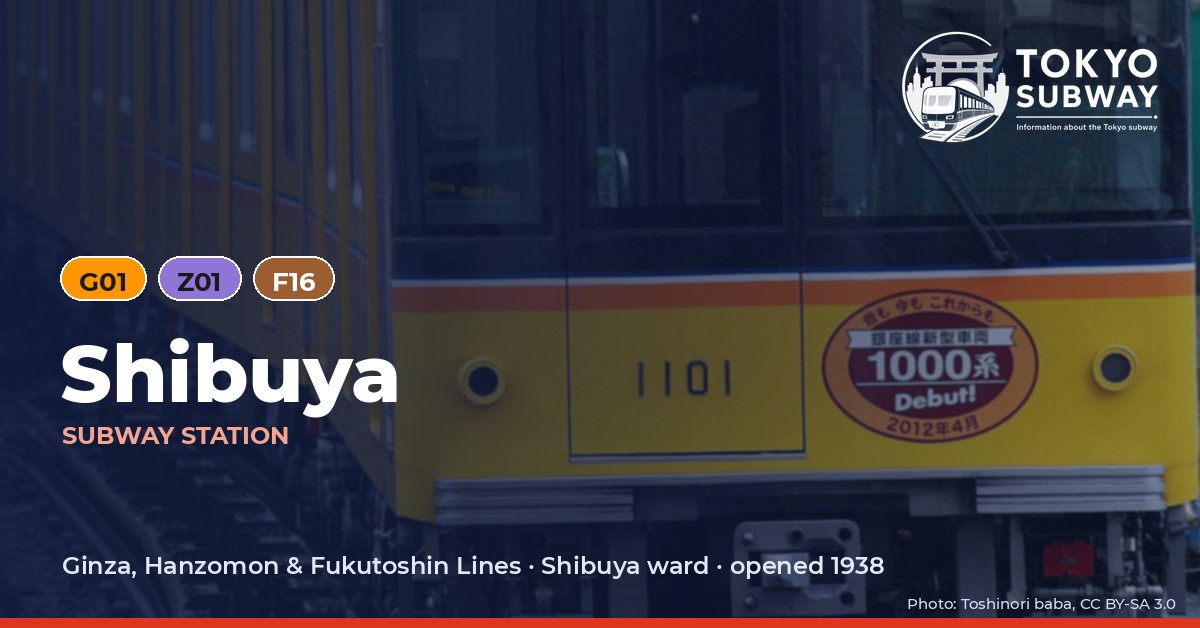
G01 Z01 F16 · Ginza Line, Hanzomon Line, and Fukutoshin Line · Shibuya
Shibuya Station (渋谷)
Three Tokyo Metro lines end at Shibuya, and none of them behaves like the others. The Ginza Line’s G01 is a stand-alone terminal with its own gateline; Z01 and F16, the Hanzomon and Fukutoshin platforms, are joined to each other inside the gates and carry on well beyond the subway — the Hanzomon onto the Tokyu Den-en-toshi Line, the Fukutoshin onto the Tokyu Toyoko and Minatomirai lines and, the other way, onto Tobu, Seibu and Sotetsu tracks.
The dates are a lifetime apart. The Tokyo Rapid Railway, forerunner of the Ginza Line, arrived in 1938; the Hanzomon Line followed on 1 August 1978 and the Fukutoshin Line on 14 June 2008. The railway itself goes back to 1 March 1885, when the place was so quiet that 16 or 17 people used the station on an average day. Tokyo Metro’s 2025 survey counted 779,659 passengers a day on the Hanzomon and Fukutoshin platforms, with another 196,339 at the Ginza Line terminal.
Finding Shibuya on the signs
Every line gives the station its own letter-and-number code. You never have to read the Japanese name to find the right platform.
Station numbers at Shibuya
Tokyo signposts every platform, exit and train door with a letter and a two-digit number. Matching the number is faster than reading the name — and it is what you will see on the map, in announcements and on the platform edge.
First and last trains at Shibuya
| Line and direction | Weekdays first – last | Saturdays, Sundays & holidays first – last |
|---|---|---|
| GGinzaG01 towards Asakusa | 05:01 – 00:02 to Ueno | 05:01 – 00:02 to Ueno |
| ZHanzomonZ01 towards Oshiage (Skytree) | 05:15 – 00:12 to Kiyosumi-shirakawa | 05:15 – 00:15 to Aoyama-itchome |
| FFukutoshinF16 towards Wakoshi | 05:05 – 00:20 to Shinjuku-sanchome | 05:05 – 00:20 to Shinjuku-sanchome |
Departure times come from the operators’ own GTFS timetables (ODPT GTFS Toei-Train-GTFS (version 20261009, valid 2026-03-14..2027-03-12) + TokyoMetro-Train-GTFS (version 20261008, valid 2026-09-19..2027-03-12)). Japan publishes two subway timetables: 平日 weekdays and 土休日 Saturdays, Sundays and national holidays. There is no separate Sunday timetable, and the December 30 – January 3 period runs the holiday timetable.
How often do trains run?
| Line | Weekdays, busiest hour | Sat / Sun / holidays, busiest hour |
|---|---|---|
| GGinza | 28 trains/hour (about one every 2.1 min) | 20 trains/hour |
| ZHanzomon | 27 trains/hour (about one every 2.2 min) | 14 trains/hour |
| FFukutoshin | 24 trains/hour (about one every 2.5 min) | 15 trains/hour |
Departures in one direction during the hour with the most trains at this station, counted in the operators’ timetable.
Next stations from Shibuya
Scheduled running time between Shibuya and the stations either side of it.
| Line | Next station | Running time |
|---|---|---|
| GGinza | G02Omote-sando | 2 min |
| ZHanzomon | Z02Omote-sando | 2 min |
| FFukutoshin | F15Meiji-jingumae (Harajuku) | 2 min |
Transfers and connections
- Subway: transfer between Ginza Line, Hanzomon Line, and Fukutoshin Line.
- JR: Saikyo-Kawagoe Line (JR East), Shonan-Shinjuku Line (JR East), Yamanote Line (JR East). These are separate railways with their own fares.
- Private railways: Inokashira Line (Keio Corporation), Den-En-Toshi Line (Tokyu Railways), Toyoko Line (Tokyu Railways). These are separate railways with their own fares.
Accessibility
| Line | Step-free by elevator | Accessible toilet | Escalator | Exits |
|---|---|---|---|---|
| GGinza | Yes | Yes | Yes | 1 |
| ZHanzomon | Yes | Yes | Yes | 1 |
| FFukutoshin | Yes | Yes | Yes | 1 |
- Ginza Line: Step-free elevator route street-gate-platform (official “1-route by elevator”). Operator page (checked Oct 20, 2026).
Taken from the operators’ own accessibility pages and nothing else. Tokyo Metro: the “1-route” (step-free street-gate-platform path by elevator, slope, stair lift or wheelchair escalator) is complete at all 180 stations; a separate list shows stations with an elevator-only 1-route.
What is near Shibuya Station?
Shibuya Hikarie rises about 130 m from the station and the Shibuya Sky observation deck about 100 m, with Shibuya 109 roughly 290 m away and Miyashita Park about 320 m. The scramble crossing is close enough that one of the mapped viewpoints is a station footbridge. Smaller things hide in the same blocks: the d47 Museum about 120 m up inside Hikarie, the Kihachiro Kawamoto doll gallery, the Tokyo Anime Center about 280 m and the WWW live venue at the far edge.
| Place | Distance (straight line) | On foot, estimated |
|---|---|---|
| Shibuya Sky 渋谷スカイ | 100 m | about 2 min |
| Shibuya Hikarie 渋谷ヒカリエ | 130 m | about 2 min |
| Tokyo Anime Center 東京アニメセンター | 280 m | about 5 min |
| Shibuya 109 SHIBUYA 109 | 290 m | about 5 min |
| Miyashita Park 宮下公園 | 320 m | about 5 min |
| Japan University of Economics 日本経済大学 | 390 m | about 6 min |
| WWW | 400 m | about 6 min |
| Kihachiro Kawamoto Doll Gallery 川本喜八郎人形ギャラリー | 100 m | about 2 min |
Places from OpenStreetMap within 400 m of the station. The walking time is an estimate (straight line plus 30 %, 80 m a minute), not a measured route. © OpenStreetMap contributors, ODbL.
Frequently asked questions
Omote-sando is usually easier. At Shibuya the Ginza Line terminal has its own fare-control area, so moving from it to the Hanzomon and Den-en-toshi platforms means leaving one station and entering another. At Omote-sando the Ginza and Hanzomon lines share platforms, and the change is a few steps.
Since 1 March 1885, when Nippon Railway opened a stop on the line that became the Yamanote Line. Use was tiny at first — an average of 16 to 17 people a day — and only grew from 1887, more than fifty years before the first subway trains reached the place in 1938.