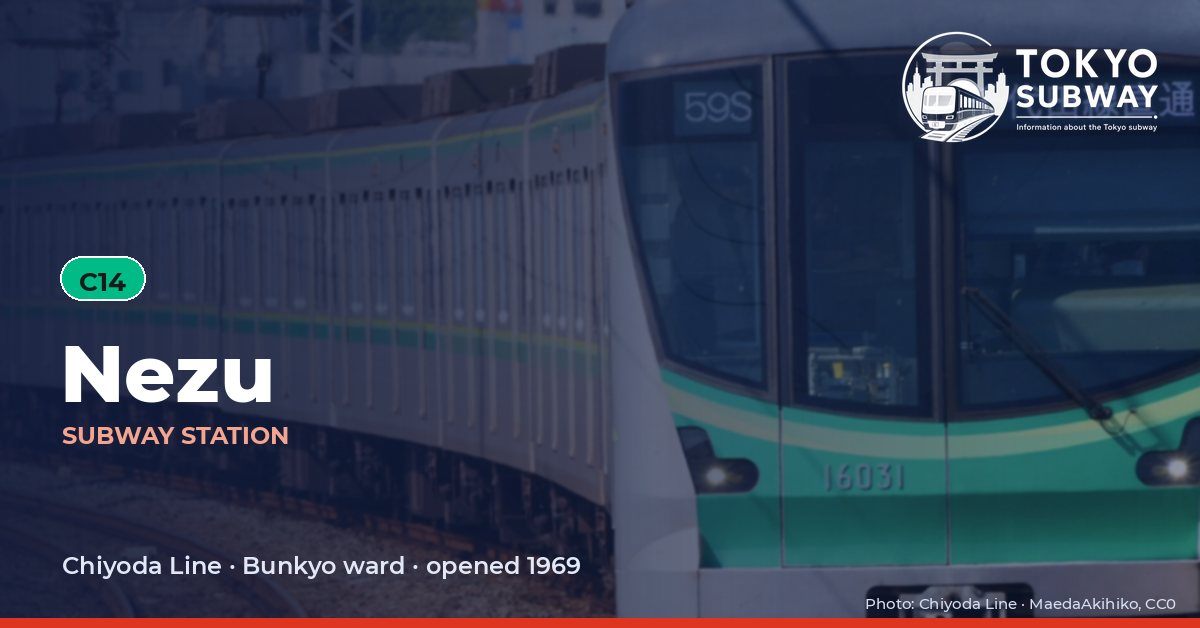
Nezu Station
C14 · Chiyoda Line · Bunkyo
Nezu Station (根津)
Nezu has one platform above the other. The streets it follows — Shinobazu-dori and the roads beyond it toward Machiya — are too narrow to carry two tunnels side by side, so the Chiyoda Line was built in two layers along this stretch, and C14 has platform 1 at 10.0 m below the surface with platform 2 directly beneath it at 15.8 m. Sendagi and Nishi-nippori were built the same way.
The station opened on 20 December 1969 with the line’s first section and has two ticket gates, one toward Shinobazu pond and one at the Nezu crossing, each reached by stairs from the street. Escalators run between the two platform levels at either end, departure melodies arrived on 27 October 2018 and platform doors in 2020. Chiyoda Line trains here run through onto JR East and Odakyu tracks, so a platform in a quiet corner of Bunkyo sends trains as far as the mountains.
Finding Nezu on the signs
Every line gives the station its own letter-and-number code. You never have to read the Japanese name to find the right platform.
Station numbers at Nezu
Tokyo signposts every platform, exit and train door with a letter and a two-digit number. Matching the number is faster than reading the name — and it is what you will see on the map, in announcements and on the platform edge.
First and last trains at Nezu
| Line and direction | Weekdays first – last | Saturdays, Sundays & holidays first – last |
|---|---|---|
| CChiyodaC14 towards Ayase | 05:01 – 00:26 | 05:01 – 00:22 |
| CChiyodaC14 towards Yoyogi-uehara | 05:13 – 00:19 | 05:13 – 00:18 to Kasumigaseki |
Departure times come from the operators’ own GTFS timetables (ODPT GTFS Toei-Train-GTFS (version 20261009, valid 2026-03-14..2027-03-12) + TokyoMetro-Train-GTFS (version 20261008, valid 2026-09-19..2027-03-12)). Japan publishes two subway timetables: 平日 weekdays and 土休日 Saturdays, Sundays and national holidays. There is no separate Sunday timetable, and the December 30 – January 3 period runs the holiday timetable.
How often do trains run?
| Line | Weekdays, busiest hour | Sat / Sun / holidays, busiest hour |
|---|---|---|
| CChiyoda | 25 trains/hour (about one every 2.4 min) | 12 trains/hour |
Departures in one direction during the hour with the most trains at this station, counted in the operators’ timetable.
Transfers and connections
Only the Chiyoda Line stops here, and no other railway serves this station, so there is nothing to transfer to inside the station.
Accessibility
| Line | Step-free by elevator | Accessible toilet | Escalator | Exits |
|---|---|---|---|---|
| CChiyoda | Yes | Yes | Yes | 2 |
- Chiyoda Line: Step-free elevator route street-gate-platform (official “1-route by elevator”). Street elevator at exit(s): 2. Operator page (checked Oct 20, 2026).
Taken from the operators’ own accessibility pages and nothing else. Tokyo Metro: the “1-route” (step-free street-gate-platform path by elevator, slope, stair lift or wheelchair escalator) is complete at all 180 stations; a separate list shows stations with an elevator-only 1-route.
What is near Nezu Station?
This is one of the densest temple quarters in the city: Myogokuin stands about 70 m from the exits, with Tengen-ji roughly 200 m, Honju-ji around 240 m and perhaps ten more within 400 m, along with Nanakura Inari shrine some 260 m away. The University of Tokyo’s Asano section is about 170 m from the station, and the Yayoi Museum and Takehisa Yumeji Museum roughly 340 m. Nezu Shrine and Ueno Zoo are the two places most visitors come out here for.
| Place | Distance (straight line) | On foot, estimated |
|---|---|---|
| Myogokuin Temple 妙極院 | 70 m | about 1 min |
| Tengen-ji 天眼寺 | 200 m | about 3 min |
| Honju-ji 本寿寺 | 240 m | about 4 min |
| Rinko-ji Temple 臨江寺 | 310 m | about 5 min |
| Gyokurinji Temple 玉林寺 | 320 m | about 5 min |
| Myokenji Temple 妙顕寺 | 320 m | about 5 min |
| Myohjoh-ji 妙情寺 | 380 m | about 6 min |
| 都電7500形 (7506号車) | 260 m | about 4 min |
Places from OpenStreetMap within 400 m of the station. The walking time is an estimate (straight line plus 30 %, 80 m a minute), not a measured route. © OpenStreetMap contributors, ODbL.
Frequently asked questions
Because of the roads above. From Nezu toward Machiya the streets the Chiyoda Line follows are not wide enough for two tunnels side by side, so one track was placed above the other. Platform 1 lies 10.0 m down and platform 2 at 15.8 m.
Sendagi, Nishi-nippori and Machiya — the run of Chiyoda Line stations built under the same narrow streets. All of them put the two directions on separate levels, so you choose your platform before you descend rather than after.