
Nakanobu Station
A03 · Asakusa Line · Shinagawa
Nakanobu Station (中延)
Nakanobu has two stations and a road between them. Tokyu’s Oimachi Line platforms, opened on 6 July 1927 by the Meguro-Kamata Electric Railway, were at ground level until a rebuilding program begun in July 1954 put them on a new viaduct and embankment: 1,020 m of new alignment, finished on 11 July 1957 at a cost of ¥300 million, which closed nine level crossings. Toei’s station, A03, opened underground on 15 November 1968 on what was then Toei Line 1, renamed the Asakusa Line in 1978.
The two exits stand about 50 m apart on opposite sides of a public street, so a transfer here means crossing the road rather than walking a passage — one station elevated, the other below ground, and no connection between them. Toei’s half is a single island platform, and trains through it run onto Keikyu, Keisei, Hokuso and Shibayama tracks beyond the subway. Togoshi and Magome are the neighboring Asakusa Line stations.
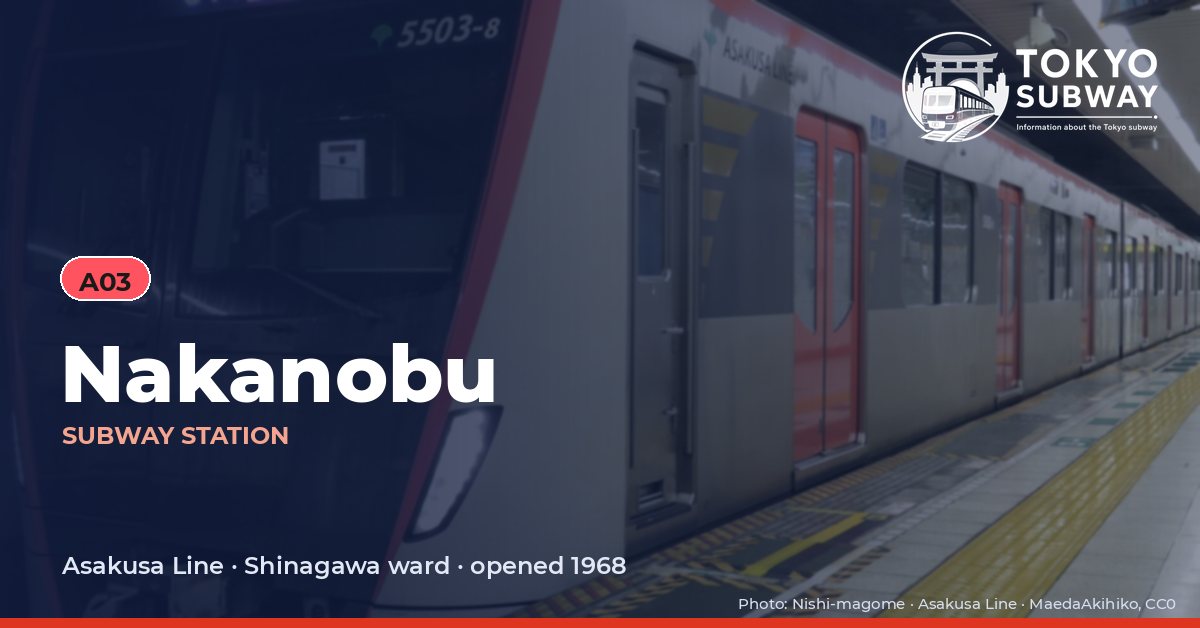
Finding Nakanobu on the signs
Every line gives the station its own letter-and-number code. You never have to read the Japanese name to find the right platform.
Station numbers at Nakanobu
Tokyo signposts every platform, exit and train door with a letter and a two-digit number. Matching the number is faster than reading the name — and it is what you will see on the map, in announcements and on the platform edge.
First and last trains at Nakanobu
| Line and direction | Weekdays first – last | Saturdays, Sundays & holidays first – last |
|---|---|---|
| AAsakusaA03 towards Oshiage (Skytree) | 05:04 – 23:53 to Sengakuji | 05:04 to Oshiage (Skytree) – 23:53 to Oshiage (Skytree) |
| AAsakusaA03 towards Nishi-magome | 05:33 – 00:28 | 05:33 – 00:28 |
Departure times come from the operators’ own GTFS timetables (ODPT GTFS Toei-Train-GTFS (version 20261009, valid 2026-03-14..2027-03-12) + TokyoMetro-Train-GTFS (version 20261008, valid 2026-09-19..2027-03-12)). Japan publishes two subway timetables: 平日 weekdays and 土休日 Saturdays, Sundays and national holidays. There is no separate Sunday timetable, and the December 30 – January 3 period runs the holiday timetable.
How often do trains run?
| Line | Weekdays, busiest hour | Sat / Sun / holidays, busiest hour |
|---|---|---|
| AAsakusa | 14 trains/hour (about one every 4.3 min) | 12 trains/hour |
Departures in one direction during the hour with the most trains at this station, counted in the operators’ timetable.
Transfers and connections
- Private railways: Oimachi Line (Tokyu Railways). These are separate railways with their own fares.
Accessibility
| Line | Step-free by elevator | Accessible toilet | Escalator | Exits |
|---|---|---|---|---|
| AAsakusa | Yes | Yes | Yes | 4 |
- Asakusa Line: Toei: step-free “1-route” secured; 2 elevator(s) on this line. Elevator exit(s): A4. Operator page (checked Oct 20, 2026).
Taken from the operators’ own accessibility pages and nothing else. Toei: every station has elevators and a street-gate-platform “1-route” is secured.
What is near Nakanobu Station?
Nakanobu covers a part of Shinagawa made up of small streets, shopping arcades and houses. Hebikubo Shrine is about 330 m from the exits, with the Genjimae elementary school roughly 300 m, the ward’s Genjimae library some 340 m and the Ebara bus depot about 340 m. Half a dozen small parks and a disaster-prevention open space lie between 200 m and 370 m, which is the shape of the neighborhood: local, flat and built up.
| Place | Distance (straight line) | On foot, estimated |
|---|---|---|
| Hebikubo Shrine 蛇窪神社 | 330 m | about 5 min |
| 東中延公園 | 200 m | about 3 min |
| 大原公園 | 210 m | about 3 min |
| 豊町公園 ゆたかちょうこうえん | 270 m | about 4 min |
| ゆたか南公園 ゆたかみなみこうえん | 280 m | about 5 min |
| 中通りの小路 なかどおりのこみち | 300 m | about 5 min |
| 上神明児童遊園 | 310 m | about 5 min |
| ゆたか防災広場 | 370 m | about 6 min |
Places from OpenStreetMap within 400 m of the station. The walking time is an estimate (straight line plus 30 %, 80 m a minute), not a measured route. © OpenStreetMap contributors, ODbL.
Frequently asked questions
By crossing the street. The Toei station is underground and the Tokyu station elevated, with their entrances roughly 50 m apart on either side of a public road, so the change is made outside the ticket gates and in the open air.
From the place name: when the Oimachi Line station opened in 1927 the site lay in Nakanobu, in the village of Ebara. What Nakanobu itself meant has never been established — the suggestions are that this was the center of the ancient Hiratsuka district, or of Ebara district, but neither is documented.