
Hikawadai Station
Y05 F05 · Yurakucho Line and Fukutoshin Line · Nerima
Hikawadai Station (氷川台)
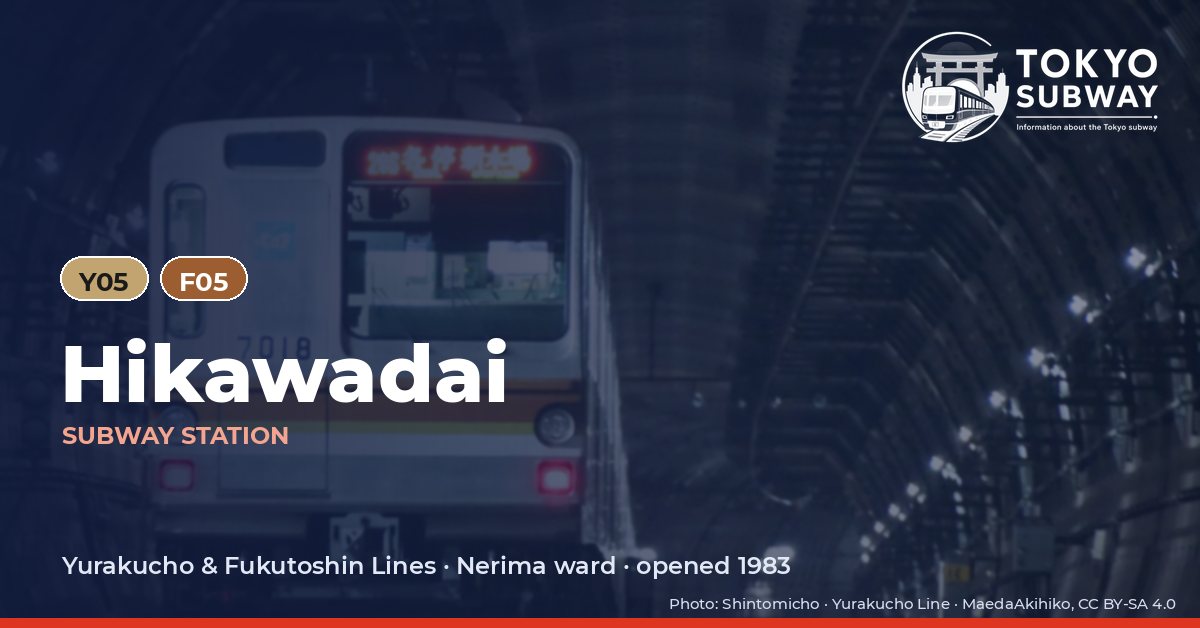
Hikawadai is the odd one out on its line. It opened on 24 June 1983 with the Yurakucho Line‘s extension toward Ikebukuro, and it has two side platforms rather than the island platform almost every other station on the line was given. The reason is the tunnel: from Heiwadai to the junction with the Seibu line near Kotake-mukaihara the railway runs in a twin-track shield bore, and the platforms had to fit the alignment that produced. Only one other station on the Yurakucho Line is built this way, and on the Fukutoshin Line it is the only one.
Platform edge doors were fitted in August 2010 and departure melodies followed in February 2011. Y05 and F05 are the same two tracks: the Fukutoshin Line has shared them since 14 June 2008, and trains from either run through beyond the subway onto Tobu and Seibu lines. The 2025 survey counted 38,725 entries and exits a day, 99th on the Tokyo Metro network.
Finding Hikawadai on the signs
Every line gives the station its own letter-and-number code. You never have to read the Japanese name to find the right platform.
Station numbers at Hikawadai
Tokyo signposts every platform, exit and train door with a letter and a two-digit number. Matching the number is faster than reading the name — and it is what you will see on the map, in announcements and on the platform edge.
First and last trains at Hikawadai
| Line and direction | Weekdays first – last | Saturdays, Sundays & holidays first – last |
|---|---|---|
| YYurakuchoY05 towards Shin-kiba | 05:10 – 23:57 to Ikebukuro | 05:10 – 23:57 to Ikebukuro |
| YYurakuchoY05 towards Wakoshi | 05:20 – 00:22 | 05:20 – 00:22 |
| FFukutoshinF05 towards Shibuya | 05:15 – 00:05 | 05:15 – 00:05 |
| FFukutoshinF05 towards Wakoshi | 05:30 – 00:19 | 05:31 – 00:19 |
Departure times come from the operators’ own GTFS timetables (ODPT GTFS Toei-Train-GTFS (version 20261009, valid 2026-03-14..2027-03-12) + TokyoMetro-Train-GTFS (version 20261008, valid 2026-09-19..2027-03-12)). Japan publishes two subway timetables: 平日 weekdays and 土休日 Saturdays, Sundays and national holidays. There is no separate Sunday timetable, and the December 30 – January 3 period runs the holiday timetable.
How often do trains run?
| Line | Weekdays, busiest hour | Sat / Sun / holidays, busiest hour |
|---|---|---|
| YYurakucho | 12 trains/hour (about one every 5 min) | 10 trains/hour |
| FFukutoshin | 10 trains/hour (about one every 6 min) | 8 trains/hour |
Departures in one direction during the hour with the most trains at this station, counted in the operators’ timetable.
Next stations from Hikawadai
Scheduled running time between Hikawadai and the stations either side of it.
| Line | Next station | Running time |
|---|---|---|
| YYurakucho | Y04Heiwadai | 2 min |
| YYurakucho | Y06Kotake-mukaihara | 3 min |
| FFukutoshin | F04Heiwadai | 2 min |
| FFukutoshin | F06Kotake-mukaihara | 3 min |
Transfers and connections
- Subway: transfer between Yurakucho Line and Fukutoshin Line.
Accessibility
| Line | Step-free by elevator | Accessible toilet | Escalator | Exits |
|---|---|---|---|---|
| YYurakucho | Yes | Yes | Yes | 2 |
| FFukutoshin | Yes | Yes | Yes | 2 |
- Yurakucho Line: Step-free elevator route street-gate-platform (official “1-route by elevator”). Operator page (checked Oct 20, 2026).
Taken from the operators’ own accessibility pages and nothing else. Tokyo Metro: the “1-route” (step-free street-gate-platform path by elevator, slope, stair lift or wheelchair escalator) is complete at all 180 stations; a separate list shows stations with an elevator-only 1-route.
What is near Hikawadai Station?
The Shakujii river runs close to the station and the land rises away from it, which is where the Hikawa Shrine that gave the district and the station their name stands. Supermarkets and chain restaurants cluster at the exits, and a minute’s walk in any direction puts you among houses and apartment blocks; a small neighbourhood park lies about 330 m away. Johoku Central Park, with sports grounds and tennis courts, is a longer walk, and Tokyo Oyama High School is among the places the station serves.
| Place | Distance (straight line) | On foot, estimated |
|---|---|---|
| 氷川台三丁目公園 | 330 m | about 5 min |
Places from OpenStreetMap within 400 m of the station. The walking time is an estimate (straight line plus 30 %, 80 m a minute), not a measured route. © OpenStreetMap contributors, ODbL.