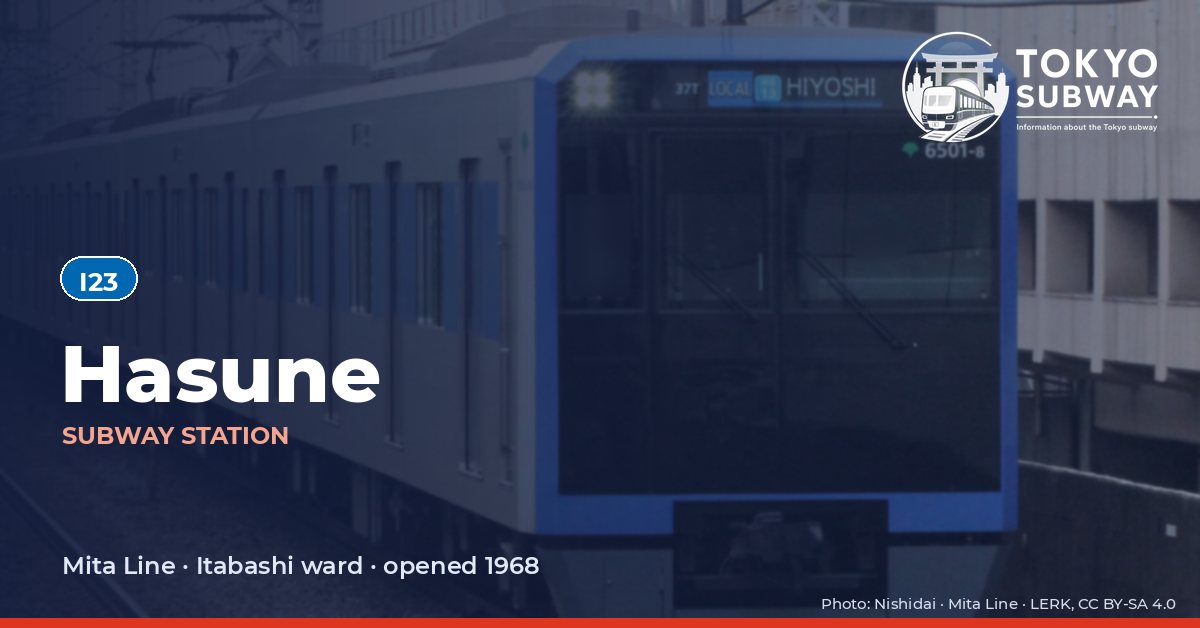
Hasune Station
I23 · Mita Line · Itabashi
Hasune Station (蓮根)
Hasune belongs to the elevated northern end of the Mita Line, the stretch Toei opened on 27 December 1968 as Line 6; the line took its present name in July 1978 and the station has carried the number I23 since numbering arrived. Its single island platform stands above the street between Shimura-sanchome and Nishidai.
Nothing dramatic has happened to it since, but it has been quietly improved: a waiting room was put up on the platform and brought into use on 5 November 2015, along with a new concourse floor and repairs to the windbreak walls, and in early 2016 the roof was painted with a helicopter identification marking. With 19,363 entries and exits on an average day in 2024 it is one of the quieter stops on the line, serving the blocks of Itabashi around it rather than drawing people in.
Finding Hasune on the signs
Every line gives the station its own letter-and-number code. You never have to read the Japanese name to find the right platform.
Station numbers at Hasune
Tokyo signposts every platform, exit and train door with a letter and a two-digit number. Matching the number is faster than reading the name — and it is what you will see on the map, in announcements and on the platform edge.
First and last trains at Hasune
Departure times come from the operators’ own GTFS timetables (ODPT GTFS Toei-Train-GTFS (version 20261009, valid 2026-03-14..2027-03-12) + TokyoMetro-Train-GTFS (version 20261008, valid 2026-09-19..2027-03-12)). Japan publishes two subway timetables: 平日 weekdays and 土休日 Saturdays, Sundays and national holidays. There is no separate Sunday timetable, and the December 30 – January 3 period runs the holiday timetable.
How often do trains run?
| Line | Weekdays, busiest hour | Sat / Sun / holidays, busiest hour |
|---|---|---|
| IMita | 19 trains/hour (about one every 3.2 min) | 12 trains/hour |
Departures in one direction during the hour with the most trains at this station, counted in the operators’ timetable.
Next stations from Hasune
Scheduled running time between Hasune and the stations either side of it.
| Line | Next station | Running time |
|---|---|---|
| IMita | I24Nishidai | 1 min |
| IMita | I22Shimura-sanchome | 2 min |
Transfers and connections
Only the Mita Line stops here, and no other railway serves this station, so there is nothing to transfer to inside the station.
Accessibility
| Line | Step-free by elevator | Accessible toilet | Escalator | Exits |
|---|---|---|---|---|
| IMita | Yes | Yes | Yes | — |
- Mita Line: Toei: step-free “1-route” secured; 1 elevator(s) on this line. Operator page (checked Oct 20, 2026).
Taken from the operators’ own accessibility pages and nothing else. Toei: every station has elevators and a street-gate-platform “1-route” is secured.
What is near Hasune Station?
The Hasune Lotus shopping street runs by the station, and the main draw nearby is the Johoku Traffic Park about 210 m away, a children’s park built around road-safety practice where a preserved D51 steam locomotive and a small train called the Baby Loco stand on display. Snake Park is roughly 260 m from the exits and another local park about 280 m. Hikawa Shrine and the Shimura police station are among the other places the station serves, with bus routes toward Akabane and Ikebukuro passing nearby.
| Place | Distance (straight line) | On foot, estimated |
|---|---|---|
| 城北公園 | 280 m | about 5 min |
| Johoku Traffic Park 交通資料館 | 210 m | about 3 min |
| D51 | 220 m | about 4 min |
| ベビーロコ号 | 250 m | about 4 min |
| へび公園 | 260 m | about 4 min |
Places from OpenStreetMap within 400 m of the station. The walking time is an estimate (straight line plus 30 %, 80 m a minute), not a measured route. © OpenStreetMap contributors, ODbL.