
Nakano-Shimbashi Station
Mb05 · Marunouchi Line · Nakano
Nakano-Shimbashi Station (中野新橋)
The name comes from a bridge. A crossing of the Kanda River near the station was called Shinbashi, which on its own would have clashed with Shimbashi in Minato ward, so the station that opened on 8 February 1961 took Nakano as a prefix; the bridge itself was renamed to match on 30 June 2011. Planning documents from 1946 had proposed calling the station Mukodaimachi.
Two side platforms on the second basement, one entrance, one ticket hall at street level: Nakano-shimbashi is a small station on the Honancho branch of the Marunouchi Line, 1.3 km from Nakano-sakaue. Platform doors and movable steps came into use on 8 May 2004 and the station building was rebuilt between December 2013 and March 2015. In November 2016 its code changed from the plain line letter to Mb05, for the Marunouchi branch, because the old number sounded identical in the automated announcements to that of Shin-nakano on the main line. The station also appeared on film in 1966, used as a location for You Only Live Twice.
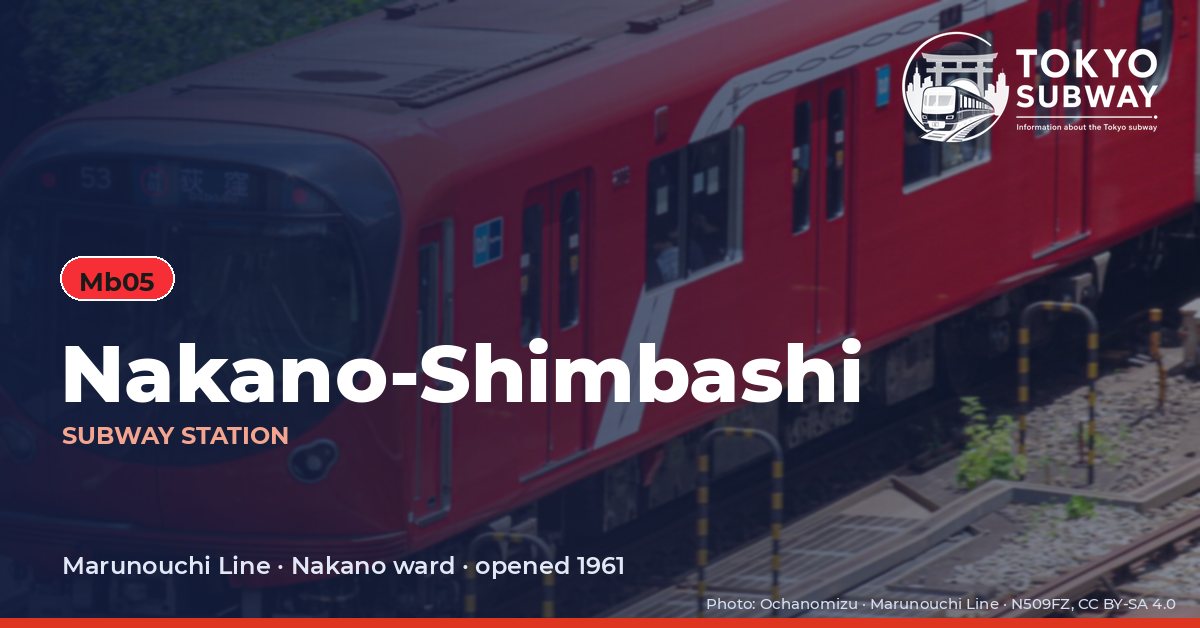
Finding Nakano-Shimbashi on the signs
Every line gives the station its own letter-and-number code. You never have to read the Japanese name to find the right platform.
Station numbers at Nakano-Shimbashi
Tokyo signposts every platform, exit and train door with a letter and a two-digit number. Matching the number is faster than reading the name — and it is what you will see on the map, in announcements and on the platform edge.
First and last trains at Nakano-Shimbashi
| Line and direction | Weekdays first – last | Saturdays, Sundays & holidays first – last |
|---|---|---|
| MMarunouchiMb05 towards Ikebukuro | 05:01 to Shinjuku-sanchome – 00:13 | 05:01 to Shinjuku-sanchome – 00:13 |
| MMarunouchiMb05 towards Ogikubo | 05:11 – 00:28 to Nakano-fujimicho | 05:11 – 00:28 to Nakano-fujimicho |
Departure times come from the operators’ own GTFS timetables (ODPT GTFS Toei-Train-GTFS (version 20261009, valid 2026-03-14..2027-03-12) + TokyoMetro-Train-GTFS (version 20261008, valid 2026-09-19..2027-03-12)). Japan publishes two subway timetables: 平日 weekdays and 土休日 Saturdays, Sundays and national holidays. There is no separate Sunday timetable, and the December 30 – January 3 period runs the holiday timetable.
How often do trains run?
| Line | Weekdays, busiest hour | Sat / Sun / holidays, busiest hour |
|---|---|---|
| MMarunouchi | 17 trains/hour (about one every 3.5 min) | 11 trains/hour |
Departures in one direction during the hour with the most trains at this station, counted in the operators’ timetable.
Next stations from Nakano-Shimbashi
Scheduled running time between Nakano-Shimbashi and the stations either side of it.
| Line | Next station | Running time |
|---|---|---|
| MMarunouchi | Mb04Nakano-fujimicho | 2 min |
| MMarunouchi | M06Nakano-sakaue | 3 min |
Transfers and connections
Only the Marunouchi Line stops here, and no other railway serves this station, so there is nothing to transfer to inside the station.
Accessibility
| Line | Step-free by elevator | Accessible toilet | Escalator | Exits |
|---|---|---|---|---|
| MMarunouchi | Yes | Yes | Not listed | 1 |
- Marunouchi Line: Step-free elevator route street-gate-platform (official “1-route by elevator”). Operator page (checked Oct 20, 2026).
Taken from the operators’ own accessibility pages and nothing else. Tokyo Metro: the “1-route” (step-free street-gate-platform path by elevator, slope, stair lift or wheelchair escalator) is complete at all 180 stations; a separate list shows stations with an elevator-only 1-route.
What is near Nakano-Shimbashi Station?
This is a residential pocket of Nakano beside the Kanda River, and the station’s catchment is small. A park lies about 100 m from the entrance and a pocket park roughly 130 m; Hongo Hikawa shrine is around 290 m away, with two temples some 330–360 m out and a building of the Tokyo Polytechnic University’s Nakano campus about 370 m. The Honcho library and several elementary schools are the other places people use the station for.
| Place | Distance (straight line) | On foot, estimated |
|---|---|---|
| 本郷氷川神社 | 290 m | about 5 min |
| 正蔵院 | 330 m | about 5 min |
| 西光山福寿院 | 360 m | about 6 min |
| 弥生町二丁目公園 | 100 m | about 2 min |
| やよいポケットパーク | 130 m | about 2 min |
| 東京工芸大学 中野キャンパス 3号館 | 370 m | about 6 min |
Places from OpenStreetMap within 400 m of the station. The walking time is an estimate (straight line plus 30 %, 80 m a minute), not a measured route. © OpenStreetMap contributors, ODbL.
Frequently asked questions
To stop an announcement confusing visitors. The branch stations used the plain Marunouchi letter until November 2016, but Nakano-shimbashi’s number then sounded exactly like Shin-nakano’s on the main line, so Tokyo Metro relettered the branch Mb, for Marunouchi branch line.
From the bridge over the Kanda River just outside, once known simply as Shinbashi. Using that alone would have duplicated Shimbashi station in Minato ward, so the station was given the Nakano prefix in 1961 — and in 2011 the bridge was officially renamed Nakano-shimbashi to match the station.